
Flowers
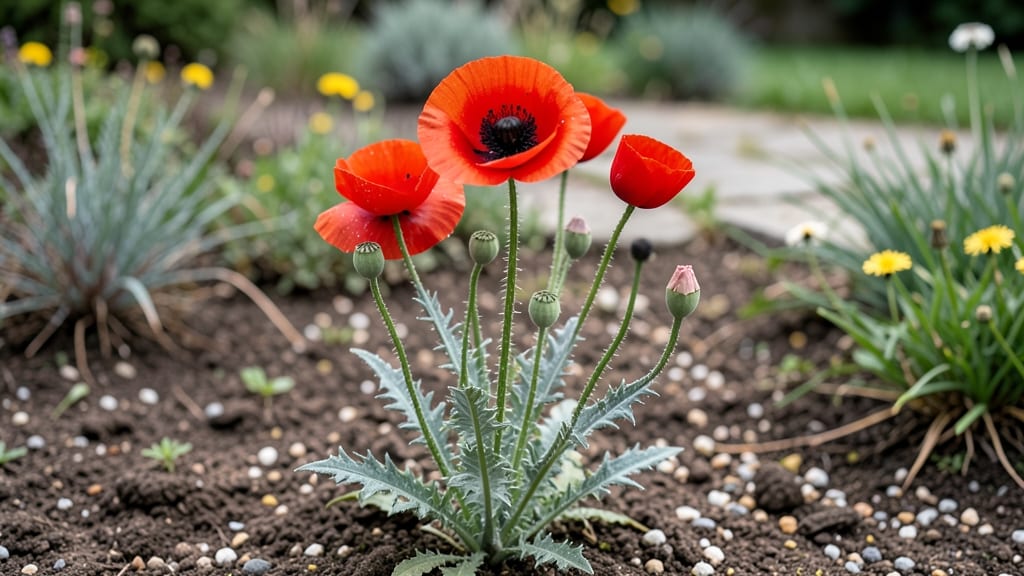
Determining whether poppy flowers are annual or perennial depends on the species—most complete their life cycle in one season, but some like the Iceland poppy may return for two years under perfect growing conditions. The key lies in their deep taproot systems, which store energy for rapid growth before seed production.
Most poppy varieties are true annuals, meaning they sprout, bloom, and set seed all in one growing season before dying back. 🌱 The exception is the Iceland poppy (Papaver nudicaule), which can sometimes behave as a short-lived perennial in cooler climates where it doesn't experience extreme heat or drought.
Their powerful taproots—some growing over 2 feet deep—store nutrients and water, allowing them to push through early spring growth before focusing on reproduction.
What makes this interesting is how these roots also give poppies their resilience. In dry conditions, the deep taproot system helps them survive longer than typical annuals, sometimes even returning for a second year if conditions remain favorable.
This is why gardeners in mild climates often see their Iceland poppies returning year after year, even though they're technically annuals by botanical definition.
💡 In This Article
- How Poppy Root Systems Dictate Lifespan
- Extending Poppy Blooms: Perennial-Like Cultivation Tips
How poppy root systems dictate lifespan
The lifespans of poppy flowers are fundamentally controlled by their deep taproot systems, which can extend 12-24 inches below the soil surface. These roots act like biological batteries, storing carbohydrates, proteins, and water during the early growth stages.
This energy reserve allows poppies to grow rapidly from seed, often reaching 6-12 inches tall in just 3-4 weeks before flowering. The stored nutrients fuel both the plant's above-ground growth and its reproductive cycle, ensuring it can complete its life cycle in one season.
In annual poppies like the opium poppy (Papaver somniferum), this root system prioritizes seed production over longevity. Once flowering occurs, the plant shifts its energy from root growth to developing seeds, which signals the beginning of its decline. The taproot then decomposes, returning nutrients to the soil.
In contrast, Iceland poppies (Papaver nudicaule) have evolved to store even more energy in their roots, allowing them to survive mild winters and return for a second year if conditions remain stable. Their roots can regenerate new shoots from dormant buds, creating the illusion of perennial behavior.
Climate plays a crucial role in how these root systems function. In hot, dry regions, the deep taproot helps poppies access water deep underground, extending their lifespan slightly.
However, in temperate or cool climates, the roots may not experience the same stress, allowing the plant to conserve energy for multiple growing seasons. This is why Iceland poppies often return in USDA Zones 3-7, where winters are cold but not extreme enough to kill the root system.
The key difference lies in how much energy the roots can store and how quickly the plant transitions from vegetative to reproductive growth.
Another fascinating aspect is how poppy roots respond to soil compaction. Unlike shallow-rooted plants, poppies can push through dense soil thanks to their strong, fibrous taproots. This adaptability explains why they thrive in poor, rocky soils where other plants struggle.
However, overly compacted or waterlogged soils can stress the roots, forcing the plant to focus on survival rather than reproduction—shortening its lifespan. Gardeners in heavy clay soils often see poppies behave more like true annuals because their roots can't penetrate deeply enough to store sufficient energy.
What most gardeners don't realize is that seed size also influences lifespan. Larger poppy seeds (like those from Papaver rhoeas) contain more stored energy, giving the seedling a head start.
This allows the plant to establish a stronger root system early, increasing its chances of surviving long enough to flower and set seed. Smaller seeds, common in wild poppies, produce plants that are more likely to complete their life cycle quickly, reinforcing their annual nature. 🌱
To visualize the difference, imagine a car battery: a fully charged one (deep, well-developed taproot) can power the plant for multiple seasons, while a weak one (shallow or damaged roots) drains quickly, leading to early death.
This analogy helps explain why Iceland poppies often "cheat" the annual/perennial definition—their roots are essentially overcharged batteries that can restart the plant under the right conditions.