
Planting
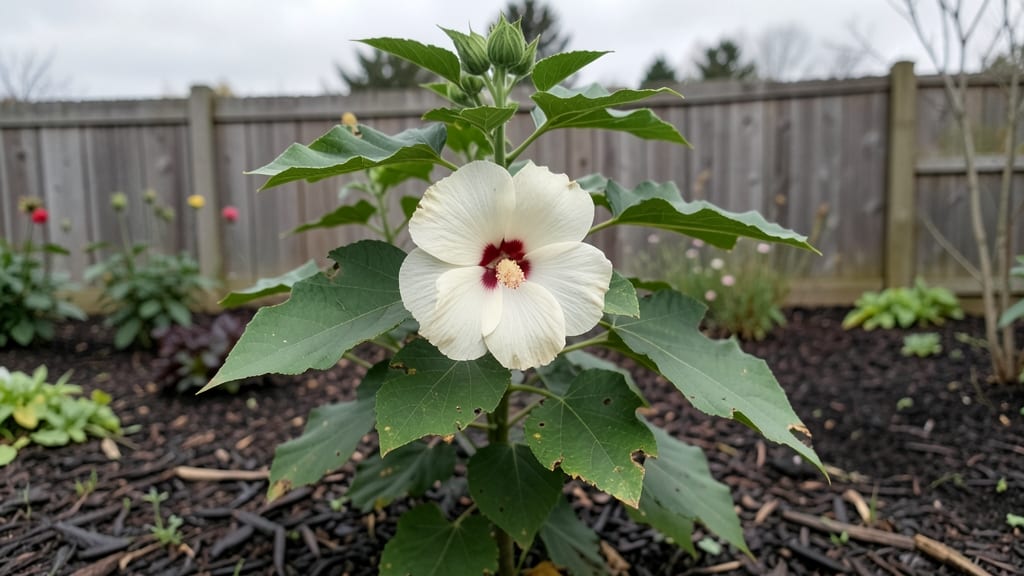
Growing perennial hibiscus in Zone 5 is absolutely doable with frost-resistant varieties like Hibiscus moscheutos (swamp rose mallow) or Hibiscus syriacus (rose of Sharon), combined with strategic winter mulching, pruning, and windbreaks to handle freezing temperatures.
These hardy hibiscus types have evolved to handle colder climates by developing thick, woody stems and deep root systems that act like natural insulation. 💫 The key to their survival lies in their ability to enter dormancy during winter months, which allows them to withstand sub-zero temperatures better than tropical varieties.
I've found that pairing these plants with a thick layer of organic mulch—like straw or shredded leaves—can raise soil temperatures by several degrees, giving roots extra protection.
What sets these Zone 5 varieties apart is their resilience during winter's harshest conditions. Unlike tropical hibiscus that die back completely, these perennials often retain some green foliage or even bloom in late summer before the first frost.
This makes them perfect for gardeners who want long-lasting color without the annual replanting hassle.
💡 In This Article
- Cold-Hardy Hibiscus Varieties for Zone 5 Gardens
- Zone 5 Winter Care Guide for Perennial Hibiscus
Cold-hardy hibiscus varieties for Zone 5 gardens
Zone 5 gardeners have three standout hibiscus species that defy winter's chill: Hibiscus moscheutos (swamp rose mallow), Hibiscus syriacus (rose of Sharon), and Hibiscus coccineus (scarlet rose mallow). These plants have evolved distinct survival mechanisms that let them thrive where tropical hibiscus would perish.
The swamp rose mallow (H. moscheutos) boasts thick, woody stems that can withstand temperatures down to -20°F, while rose of Sharon (H. syriacus) features dense, multi-branched growth that forms a protective canopy over its roots. 🔥
What sets these varieties apart is their root structure. H. moscheutos develops deep taproots that extend 3-5 feet below ground, insulating against frost penetration, while H. syriacus has extensive lateral roots that spread 4-6 feet wide, creating a natural thermal blanket.
The scarlet rose mallow (H. coccineus) combines both strategies with semi-woody stems and a 2-3 foot root system that stores carbohydrates for winter regrowth. These adaptations let them enter dormancy while maintaining enough energy reserves to leaf out early in spring.
The key to their winter survival lies in their growth habits. H. moscheutos grows 5-8 feet tall with broad, tropical-looking leaves that die back completely in winter but regrow from the root crown. H. syriacus, meanwhile, keeps its skeletal structure year-round, with buds protected in leaf axils that remain viable even after -15°F temperatures.
This persistent framework provides visual interest even during dormancy. The scarlet rose mallow offers a middle ground, with partially deciduous foliage that provides some winter protection while still allowing light penetration. ✨
Here's what their zone ranges actually mean for gardeners: H. moscheutos thrives in Zones 4-9, H. syriacus handles Zones 5-9, and H. coccineus prefers Zones 5-8.
The difference comes down to their native habitats - H. moscheutos originates from North American wetlands where it experiences seasonal flooding that naturally insulates roots, while H. syriacus comes from Mediterranean climates with dry winters that prevent root rot.
This explains why H. moscheutos handles wet Zone 5 winters better than H. syriacus in poorly-drained soils.
What most gardeners don't realize is how these plants time their dormancy cycles. All three species begin preparing for winter in late summer by slowing growth and redirecting nutrients to roots and stems.
By October, they've typically stopped flowering and started dropping leaves, with H. moscheutos often retaining some foliage until November. This gradual transition prevents shock that could occur with sudden temperature drops.
The science behind this involves a hormonal shift where abscisic acid increases, triggering bud dormancy while maintaining some cellular activity to prevent freezing damage. 💫
For visual identification, here's how to tell them apart in winter: H. moscheutos has thick, cane-like stems with visible leaf scars, H. syriacus shows multiple branching points with small bud clusters, and H. coccineus has slightly hairy stems with more pronounced leaf axils.
These physical traits help you identify which variety you're working with when planning winter care - a crucial distinction since H. moscheutos needs more protection from wet snow while H. syriacus benefits from pruning to encourage new growth in spring.