
Flowers
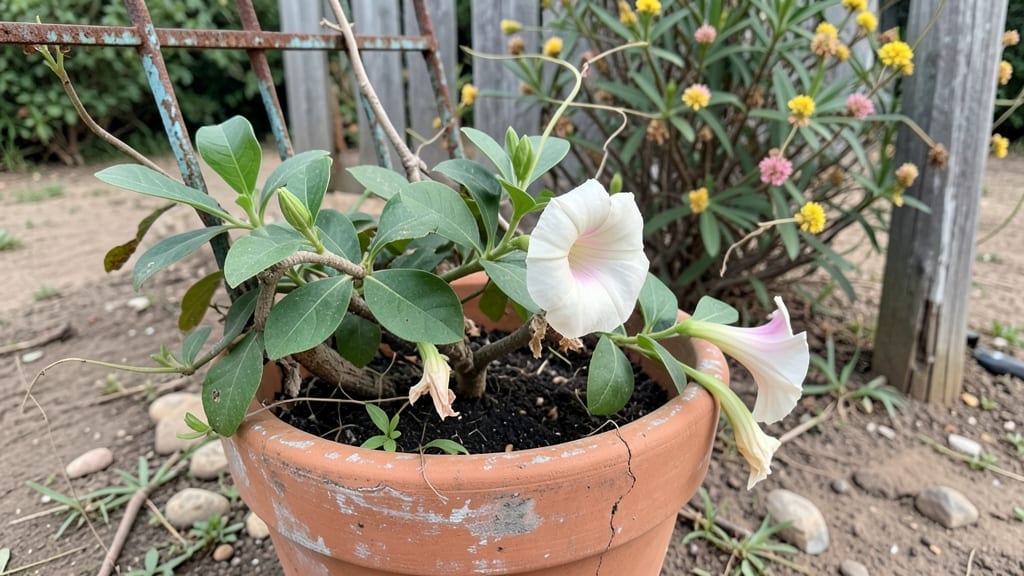
Mandevilla is not a true perennial in cold climates but behaves as a tropical evergreen in USDA Zones 10-12. It dies back in frost but often regrows from roots if protected or replanted annually in colder regions.
Mandevilla's tropical origins mean it thrives where temperatures stay above 32°F—any colder, and frost kills the above-ground growth. 🌿 The good news? Its roots often survive underground, allowing regrowth when conditions warm again.
Unlike true perennials like oleander, which regenerate from woody stems, Mandevilla relies on its root system, making winter protection key. In colder zones, gardeners often treat it as an annual or use overwintering techniques to extend its lifespan.
This behavior explains why Mandevilla is classified as a semi-evergreen in frost-free climates. Its ability to regrow from roots makes it more resilient than many tropical plants, but it still requires careful attention in marginal zones.
For example, in Zone 9, heavy mulching or container growing can help simulate its native tropical conditions.
💡 In This Article
- Mandevilla’s Cold Tolerance and Regrowth Mechanics
- Overwintering Mandevilla in Cold Climates
Mandevilla’s cold tolerance and regrowth mechanics
Mandevilla’s frost sensitivity stems from its tropical ancestry, where it evolved in regions with consistent warmth. The plant’s cells begin to suffer irreversible damage when temperatures drop below 32°F, as ice crystals form within its thin, succulent-like stems and leaves.
Unlike cold-hardy perennials, Mandevilla lacks protective adaptations like thick bark or deep root systems to store reserves for regeneration. Its growth habit prioritizes rapid vine expansion over structural resilience, making it vulnerable to even light frosts.
The key to understanding its regrowth lies in its root system. While above-ground growth dies back at 32°F, the roots often survive if protected by mulch or soil insulation.
This is where Mandevilla differs from true perennials like oleander (Zone 8 hardiness): oleander regenerates from woody stems that contain stored nutrients, while Mandevilla relies entirely on its fleshy roots.
The roots can remain viable for months if kept above 40°F, allowing new shoots to emerge when temperatures rise.
What most gardeners don’t realize is how quickly Mandevilla’s root system can react to warmth. Within 2-3 weeks of consistent temperatures above 55°F, new growth often appears from the roots, sometimes even before the old stems are fully decomposed.
This rapid response explains why many gardeners in Zone 9 successfully overwinter Mandevilla with minimal protection—its roots act like a biological reset button when conditions improve.
Comparing Mandevilla to other tropical plants reveals its unique resilience. While most tropicals (like hibiscus) die completely in frost, Mandevilla’s root survival gives it a survival advantage. The trade-off? Its regrowth is less predictable than true perennials.
For example, a 10°F freeze might kill Mandevilla’s roots if they’re exposed, whereas oleander would shrug off similar temperatures from its hardened stems.
Here’s the science behind the survival threshold: Mandevilla’s root cells contain higher concentrations of soluble sugars and water, which lower the freezing point of their cellular fluids. This natural antifreeze mechanism allows roots to survive brief cold snaps, but prolonged exposure below 32°F disrupts cellular membranes permanently.
The plant’s tropical origin means it’s adapted to consistent warmth rather than seasonal dormancy.
The practical implication is clear: Mandevilla’s "perennial-like" behavior depends entirely on root protection. Without it, the plant behaves more like an annual, requiring replanting each season.
This explains why gardeners in Zone 8 often treat it as a seasonal container plant—its tropical nature makes it a high-maintenance "perennial" compared to native species.