
Flowers
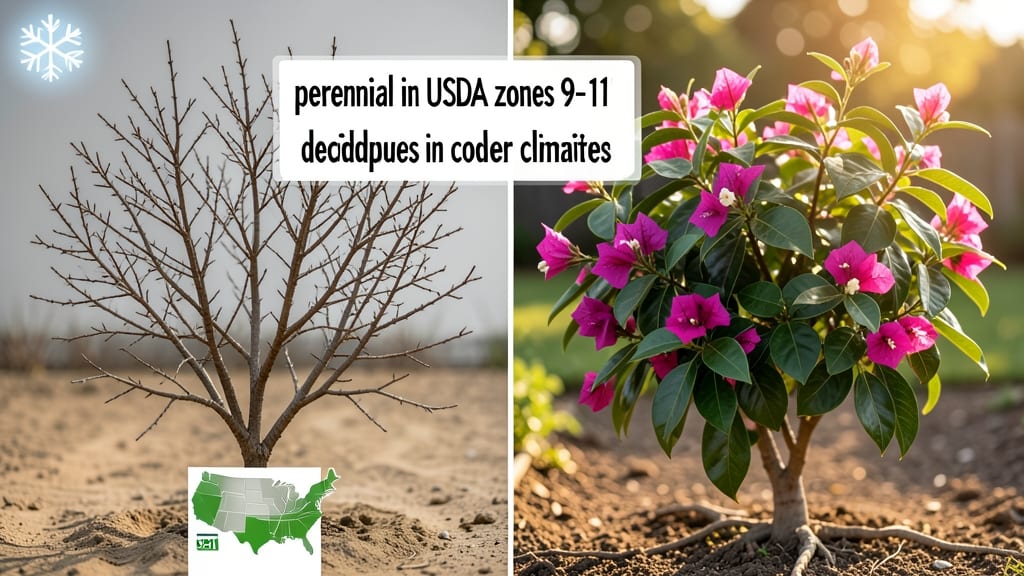
Bougainvillea isn't a true perennial in cold climates, since it loses its foliage and stems when temperatures fall below 30°F (-1°C), though many varieties regrow from their root systems if protected or replanted in warmer areas.
This tropical plant thrives in USDA zones 9-11, where it blooms continuously year-round. 🌿 The confusion often comes from its ability to regrow from roots—even after a hard freeze—making it seem perennial when it's technically a frost-sensitive shrub.
Some gardeners treat it as a seasonal plant, cutting it back annually to encourage new growth in spring.
What sets bougainvillea apart is its resilience: while it won't survive winter outdoors in colder zones, many cultivars bounce back vigorously from dormant roots when temperatures rise. This makes it a popular choice for container gardening in temperate climates, where it can be moved indoors during winter months.
💡 In This Article
- Why Bougainvillea Dies in Cold Climates
- Reviving Bougainvillea After Freeze Damage
Why bougainvillea dies in cold climates
Bougainvillea's tropical origins explain why it struggles in cold climates. Native to South America's arid regions, this plant evolved to thrive in consistent 70-90°F (21-32°C) temperatures with minimal frost exposure. Its cells lack the antifreeze proteins found in cold-hardy perennials, making them vulnerable when temperatures dip below 30°F (-1°C).
At this threshold, ice crystals form in the plant's vascular system, rupturing cell walls and causing irreversible damage to stems and leaves—a process called freeze desiccation. 🌡️
The plant's survival strategy lies in its roots, which can remain dormant and alive even when above-ground growth dies back. Studies show bougainvillea roots can survive temperatures down to 20°F (-6°C) if protected by mulch or soil insulation, though prolonged exposure to 25°F (-4°C) or colder often kills them too.
This explains why some gardeners report regrowth after mild freezes—it's the roots, not the stems, that carry the plant through winter.
What makes bougainvillea unique is its topkill vs. root survival dynamic. Unlike true perennials that maintain above-ground structure through winter, bougainvillea sheds everything above the soil line when stressed.
This complete defoliation might seem like total death, but the root crown often remains viable, ready to sprout new shoots when temperatures warm again. In USDA zones 9-11, this natural cycle happens annually without human intervention.
Cultivar differences play a major role in cold tolerance. Varieties like 'San Diego Red' and 'California Gold' show slightly better hardiness (25-28°F (-4 to -2°C) tolerance) compared to tropical hybrids that may die at 35°F (2°C).
The key factor is the plant's ability to enter dormancy—when nights stay above 40°F (4°C) consistently, bougainvillea remains active and vulnerable to freeze damage. This is why gardeners in marginal zones often treat it as an annual or use overwintering techniques.
Another critical factor is wind exposure. Cold air moving across the plant accelerates moisture loss from exposed tissues, increasing freeze damage. This is why bougainvillea planted near walls or fences often survives better in cold snaps—those structures create microclimates that trap heat and reduce wind chill.
The plant's thin, papery leaves also make it susceptible to radiation frost, where clear nights allow heat to escape rapidly from the ground up. 🌬️
Understanding these mechanisms helps explain why bougainvillea behaves differently in various climates. In its native habitat, it grows as a woody vine year-round, but when transplanted to colder regions, its survival becomes dependent on human intervention or natural root protection.
This dual nature—tropical plant with perennial-like regrowth—is what creates the confusion about its true perennial status.