
Flowers
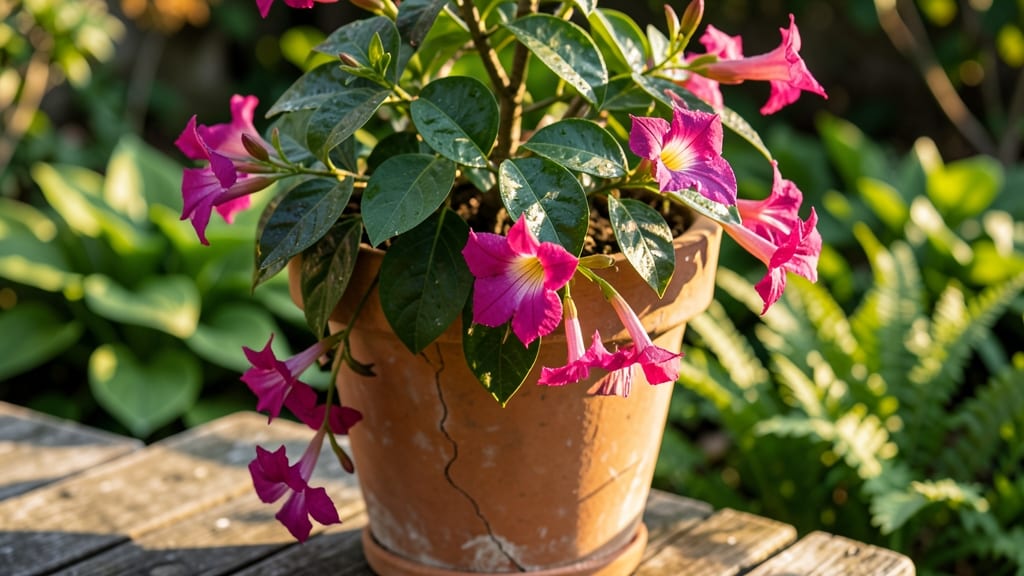
Mandevilla is a perennial only in warm climates (USDA zones 9-11)—outside those zones, it behaves as an annual, dying back when temperatures drop below freezing. Proper winter care is essential to revive it each season in colder regions.
Mandevilla's tropical roots explain why it struggles in cold weather. 🌿 Native to South America, this plant thrives in heat but freezes when temperatures dip below 30°F. In colder zones, gardeners must either dig up tubers for indoor storage or provide heavy mulch and greenhouse protection.
The key difference between true perennials and mandevilla lies in its cold sensitivity—most perennials survive winter dormancy, while mandevilla needs active protection to return each year.
Even in ideal conditions, mandevilla's growth cycle depends entirely on climate. Without winter care, it will die back completely, requiring new plants each spring. This makes it a tender perennial—a plant that lives multiple years only with special conditions, unlike hardy perennials that survive winters naturally.
💡 In This Article
- Mandevilla’s Perennial Status by USDA Hardiness Zones
- Winter Survival Strategies for Mandevilla in Cold Climates
Mandevilla’s perennial status by USDA hardiness zones
Mandevilla's perennial status hinges entirely on climate—specifically, its tropical origins from South America's warm, frost-free regions. This vine thrives as a true perennial only in USDA zones 9-11, where winter temperatures rarely drop below 20°F.
The plant's biological mechanism involves semi-deciduous behavior: in colder zones, the above-ground growth freezes at 28°F, while the root system remains dormant but viable for regrowth when warmed.
The critical threshold lies in cell membrane integrity. Mandevilla's cells lack the antifreeze proteins found in hardy perennials like hostas.
When exposed to 32°F or below, ice crystals form in the vascular system, rupturing cells and killing the plant. 🌡️ In contrast, zone 9-11 winters (typically 40-60°F) allow the plant to maintain metabolic activity through mild winters, enabling true perennial behavior.
Even a single hard freeze (25°F) can devastate unprotected mandevilla in zone 8 or colder.
This cold sensitivity explains why mandevilla behaves as an annual in frost-prone areas. Unlike hardy perennials that enter deep dormancy, mandevilla's growth cycle halts completely when frozen. The root system may survive 1-2 weeks of 28°F temperatures, but prolonged exposure or repeated freeze-thaw cycles guarantee death.
This makes it a "tender perennial"—a category that includes plants like bougainvillea and hibiscus, which require winter protection to persist annually.
Geographic patterns reinforce this division. In Florida (zone 9b-10a), mandevilla grows year-round with minimal care, while in Texas (zone 8a-9b), gardeners must implement winter strategies to prevent dieback.
The 30°F line acts as nature's dividing line: north of this, mandevilla becomes a seasonal plant unless actively protected. 🌍 This geographic limitation isn't unique—many tropical plants (like croton or plumeria) share this cold sensitivity, requiring similar care adjustments.
What most gardeners overlook is the plant's growth response to temperature shifts. Mandevilla's flowering triggers at 70-80°F and ceases below 55°F. In colder zones, this means the plant may produce flowers in summer but enters a vegetative stall by early fall—a clear sign it's preparing for dormancy.
Without intervention, this stall becomes permanent when winter arrives, terminating the plant's life cycle until new plantings emerge in spring.
Understanding this biological reality transforms mandevilla from a "difficult perennial" to a manageable seasonal plant. The key insight? Mandevilla's perennial status isn't fixed—it's a conditional trait determined by climate manipulation.
With proper winter strategies (which we'll explore next), gardeners can effectively "reset" the plant's annual cycle, creating a perennial-like experience in colder climates. 💡