
Flowers
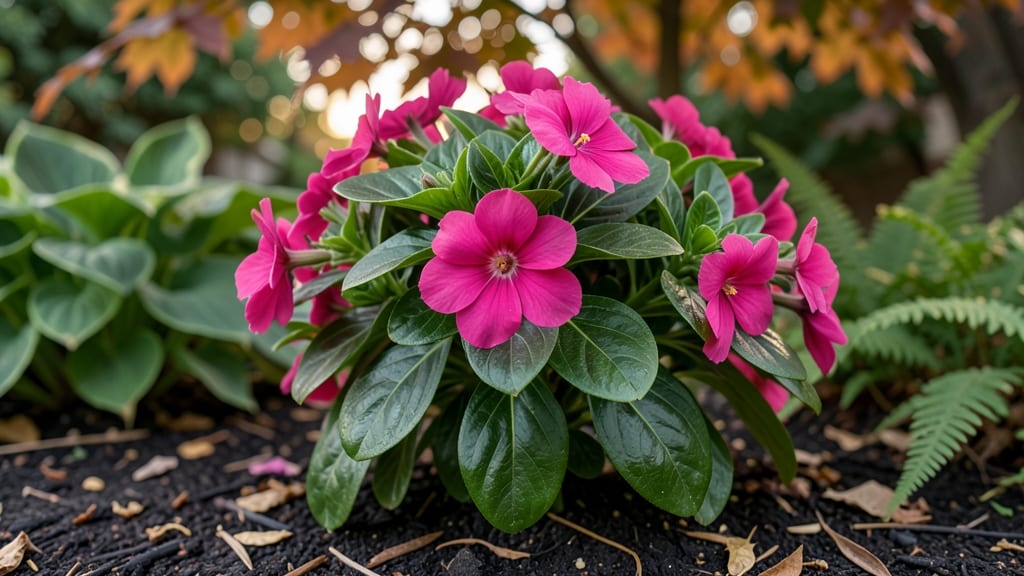
Whether impatiens act as annuals or perennials depends on your climate—most growers treat them as annuals, but their hardy rhizomes let certain varieties persist through mild winters in frost-free zones, effectively making them perennials. Temperature thresholds and winter protection decide their survival each year.
These vibrant flowers thrive as annuals in cooler regions because freezing temperatures kill their tops, but the hidden rhizomes store energy to regrow when conditions warm again. 🌱 In zones 8-11, where winters rarely drop below 20°F, impatiens can overwinter safely with proper mulching—this is how they transition from annuals to perennials.
The key difference lies in how well they tolerate cold snaps; even a light frost can reset their growth cycle.
For gardeners in marginal zones, adding 3-4 inches of mulch in late fall creates insulation, while container-grown impatiens can be moved indoors during cold snaps. This simple strategy turns what would normally be a one-season plant into a long-lived garden staple.
The rhizomes' ability to regenerate makes all the difference between a fleeting summer bloom and a reliable perennial performer.
💡 In This Article
- How Impatiens Rhizomes Influence Their Lifespan
- Climate Zones Where Impatiens Survive as Perennials
How impatiens rhizomes influence their lifespan
Impatiens rely on their thick, tuber-like rhizomes to act as biological batteries, storing carbohydrates and nutrients during dormancy. These underground structures can swell to about 1-2 inches in diameter when fully developed, packing enough energy to fuel regrowth after winter.
The rhizome's ability to regenerate stems and leaves depends on how well it survives cold exposure—below 28°F, most varieties will die back completely, forcing a full annual cycle.
The rhizome's survival mechanism is fascinating: it produces a natural antifreeze compound that lowers its internal freezing point by 2-3°F, giving it a slight edge against light frosts.
However, prolonged exposure to 20°F or colder triggers irreversible damage to cell membranes, halting regeneration. 🌱 This is why impatiens in zones 7 and below are typically annuals—they simply can't endure the winter chill.
In contrast, varieties like Impatiens walleriana (the common garden impatiens) can persist in zones 8-11 where winters rarely drop below 20°F.
What makes this adaptation so clever is how the rhizome prioritizes energy storage over immediate growth. During summer, the plant diverts up to 40% of its photosynthesis output into the rhizome, building a reserve that can sustain regrowth for 4-6 weeks after dormancy.
This stored energy allows perennials to emerge earlier in spring, giving them a competitive edge over annuals that must start from seed each year.
There's also a fascinating trade-off: rhizomes that store more energy grow slower during the active season because they're diverting resources underground. This is why perennial impatiens often have slightly smaller blooms than their annual counterparts—they're investing in longevity rather than immediate floral display.
Gardeners in marginal zones can push this adaptation further by using black plastic mulch, which raises soil temperatures by 5-10°F and extends the growing season by 2-3 weeks.
The rhizome's depth plays a crucial role too. Most impatiens rhizomes develop 6-12 inches below the surface, where soil temperatures remain 10-15°F warmer than at ground level.
This natural insulation is why surface mulching (like straw or leaves) becomes so effective—it mimics the plant's own protective strategy by creating a warmer microclimate around the rhizome.
Here's what most gardeners miss: even in perennial zones, impatiens need active winter care to thrive beyond their first year. Simply leaving them unprotected often results in weak regrowth because the rhizome's energy reserves get depleted trying to survive fluctuating temperatures.
The solution? A 3-inch layer of shredded bark mulch applied in late fall creates a consistent 5°F warmer environment around the rhizome, making all the difference between a robust perennial and a struggling annual.