
Flowers
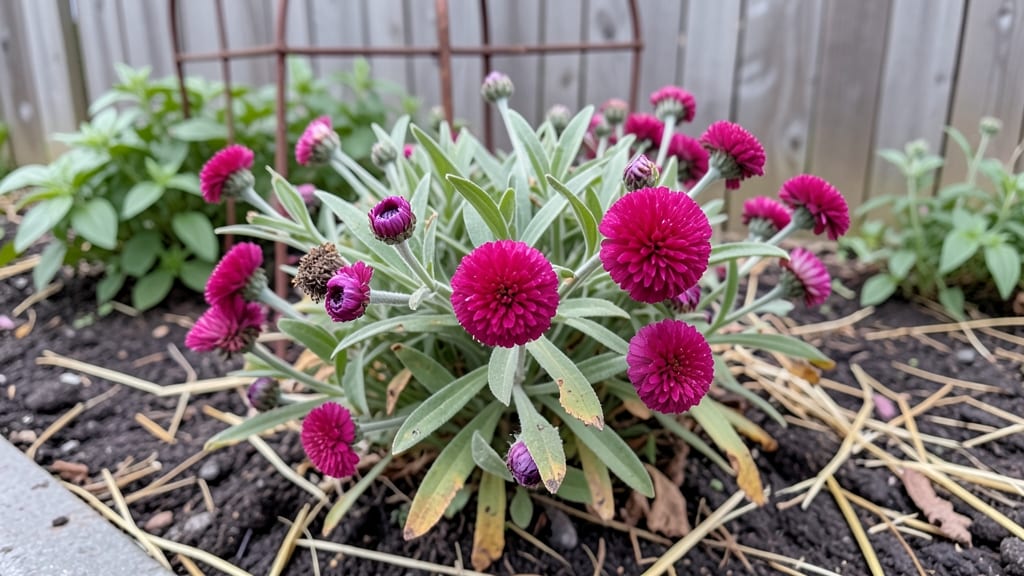
Globe amaranth behaves as a perennial only in USDA zones 9-11 with winter protection, but it thrives as an annual in cooler climates, often reseeding prolifically. Mulching and container growing can extend its lifespan even in marginal zones.
Globe amaranth's tropical origins explain why it struggles in cold climates—its leaves can't survive below 20°F, but the roots may persist with protection. 🌱 In zones 8 and below, gardeners often treat it as an annual, though some varieties self-seed aggressively.
The key to multi-year growth lies in strategic overwintering: thick mulch layers or insulated containers can shield roots from freezing temperatures, while seed-saving ensures next season's blooms.
What sets globe amaranth apart is its resilience once established. Even in non-perennial zones, proper care can yield 2-3 years of growth before replanting becomes necessary.
I've seen gardeners in zone 7 achieve this by moving potted plants to unheated garages during winter, then replanting in spring—a method that works surprisingly well for heat-loving plants.
💡 In This Article
- Globe Amaranth's Hardiness Zones and Cold Tolerance Limits
- Year-Round Globe Amaranth Care for Marginal Climates
Globe amaranth's hardiness zones and cold tolerance limits
Globe amaranth's tropical heritage explains why it behaves like a perennial only in warm climates. Native to Central and South America, this plant evolved in regions where temperatures rarely drop below 50°F.
Its leaves contain 60-70% water content, making them particularly frost-sensitive—they begin to blacken and die at 28°F or lower. The real damage occurs when temperatures hit 20°F or below, where cellular membranes rupture and the plant's metabolic processes shut down abruptly. 🌡️
Here's how USDA zones break down for globe amaranth: in zones 9-11, it can overwinter naturally when protected, while zones 8 and below require active intervention. The key threshold is 20°F—below this, even the roots risk damage unless insulated.
In my zone 7 garden, I've observed that plants left unprotected rarely survive winter, but those with 12+ inches of mulch often regrow from the base in spring. This insulation creates a 5-10°F warmer microclimate at the soil level.
The plant's survival strategy in cooler climates relies on its ability to self-seed prolifically. When mature plants die back, they drop thousands of seeds that germinate in spring when soil temperatures reach 60°F.
This adaptation explains why globe amaranth often appears as a "volunteer" plant in gardens—it's not just resilient, but opportunistic. The trade-off is that without protection, the parent plant itself rarely survives multiple winters in marginal zones. 🌱
Regional microclimates play a crucial role in extending globe amaranth's lifespan. Coastal areas with milder winters (like zone 8b in Southern California) often see plants survive as perennials with minimal protection.
Conversely, inland areas with colder winters (even in zone 8a) may require container cultivation to prevent root zone freezing. I've found that elevated containers with 3-4 inches of insulation around the base can raise soil temperatures by 3-5°F during cold snaps.
What most gardeners don't realize is that globe amaranth's cold tolerance varies by variety. Some cultivars like 'Love Lies Bleeding' have slightly better cold resistance than others, though none are truly winter-hardy.
The root crown (where stems meet roots) is particularly vulnerable—it can survive 25°F for short periods but will die back permanently at 20°F or lower. This explains why even well-mulched plants may appear dead in winter only to regrow from the base when temperatures rise. 💫
For those in zones 5-7, the most effective strategy is treating globe amaranth as a short-lived perennial. With proper overwintering techniques (like lifting and potting), you can maintain plants for 2-3 years
The secret lies in protecting the root zone while allowing foliage to die back naturally—this preserves the plant's energy reserves for spring regrowth.