
Orchid Care
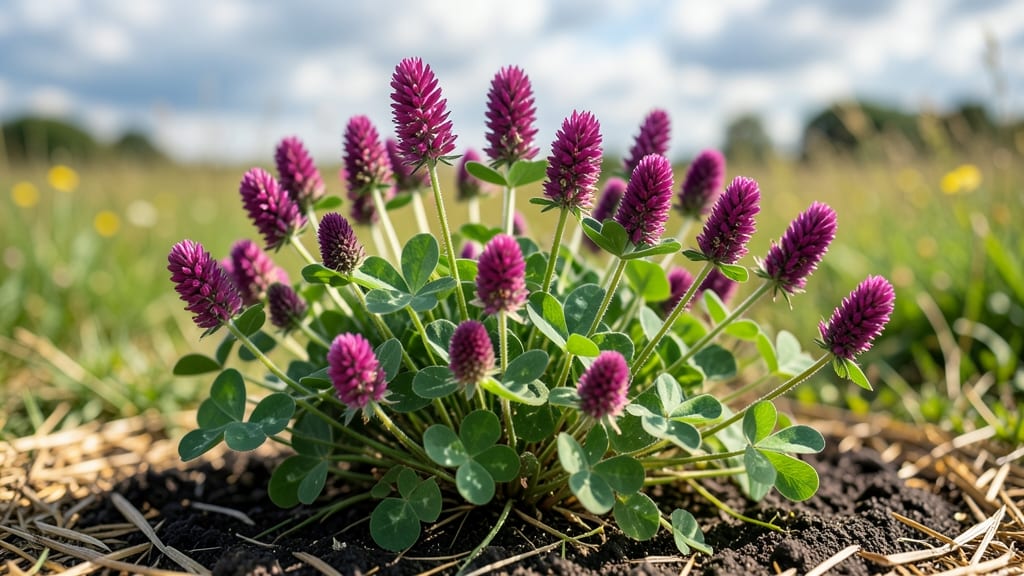
Determining whether crimson clover is annual or perennial depends on your climate: it acts as a short-lived perennial in mild winter zones but dies back completely each year in colder regions, often regrowing from seed. Its persistence hinges on soil conditions and winter hardiness rather than fixed botanical classification.
Crimson clover's behavior shifts dramatically based on where you grow it.
In warmer zones (USDA 8-10), it thrives as a true short-lived perennial, lasting 2-3 years before declining naturally. 🌱 However, in colder climates (USDA 3-7), it typically dies back to the ground each winter—only to resprout from seed or surviving roots when temperatures rise.
This makes it function like an annual in harsh winters, even though it's botanically classified as a perennial.
What's fascinating is how its growth cycle adapts: in mild winters, established plants may survive, while in freezing conditions, only fresh seed germination keeps it going. This flexibility is why many gardeners plant it annually—they rely on its fast establishment and nitrogen-fixing benefits rather than long-term persistence.
💡 In This Article
- Why Crimson Clover Dies Back Like an Annual
- How to Extend Crimson Clover’s Lifespan in Gardens
Why crimson clover dies back like an annual
Crimson clover's behavior stems from its cold sensitivity—its roots and crowns struggle to survive freezing temperatures below 15°F. In colder climates (USDA zones 3-7), the entire plant dies back to the ground each winter, only to regenerate from seeds or surviving root fragments when spring arrives.
This cycle mimics annual behavior, even though botanically it's classified as a short-lived perennial. The key difference lies in its ability to persist through mild winters, where established plants may survive and regrow from the same root system.
What makes this fascinating is the plant's survival strategy: in freezing conditions, crimson clover prioritizes seed production over root survival.
This ensures genetic continuity even when the parent plant perishes. 🌱 In contrast, in warmer zones (USDA 8-10), the plant often behaves as a true perennial, living 2-3 years before naturally declining.
The transition between these behaviors occurs at roughly 20°F—the threshold where cold damage becomes severe enough to kill the crown.
The plant's dormancy mechanism also plays a role. Unlike true annuals, crimson clover can remain dormant for extended periods, waiting for favorable conditions. This explains why you might see patches resprouting from the same roots in spring—some portions of the root system may have survived just enough to regenerate.
The plant's ability to regrow from both seed and roots gives it remarkable adaptability across different climates.
Here's where USDA hardiness zones become crucial: in zone 7, you might get partial winter survival, while zone 5 typically sees complete dieback. The plant's response to temperature isn't binary—it's a spectrum where survival depends on how long temperatures remain below freezing and how severe the cold becomes.
This is why gardeners in transitional zones often see inconsistent performance from year to year.
Soil health compounds this effect. Well-drained, fertile soil provides better insulation against temperature fluctuations, while heavy clay soils can exacerbate cold damage.
The plant's nitrogen-fixing abilities also mean it competes less with surrounding vegetation, which can help it establish faster in spring—another reason it often appears annual in colder regions where competition is fierce after winter.
What most people overlook is the plant's seed bank strategy. Crimson clover produces thousands of seeds per plant, which can remain viable in the soil for years.
This seed reservoir means even if the parent plant dies back completely, new plants will emerge when conditions improve—creating the illusion of annual behavior while actually relying on perennial survival mechanisms.