
Flowers
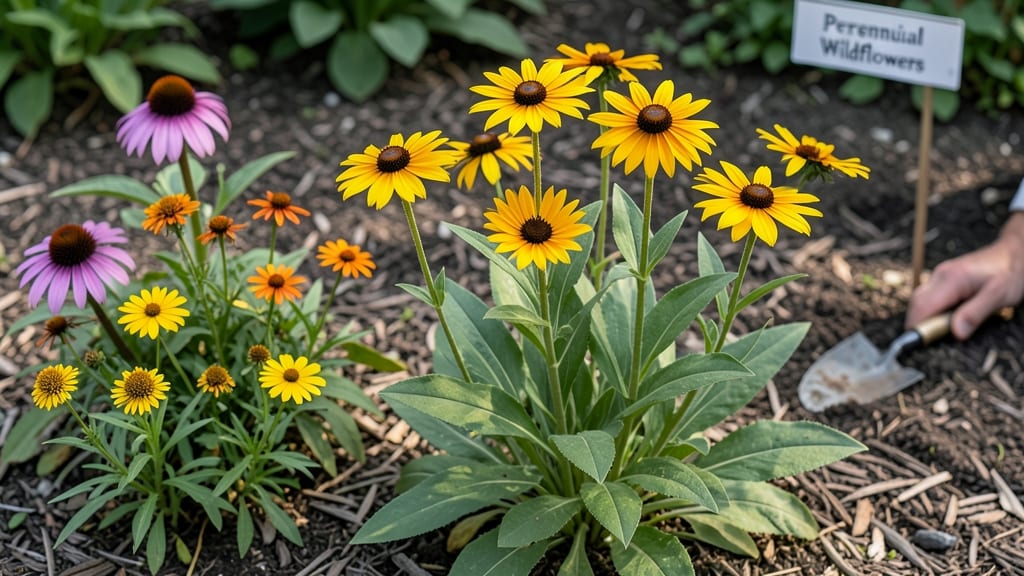
Not all wildflowers are perennials—some are annuals or biennials, meaning their life spans vary from one to two years. While perennials return yearly, others complete their cycle and may self-seed or go dormant seasonally.
Wildflowers actually fall into three main categories: annuals, biennials, and perennials. 🌸 Annuals like cosmos bloom vigorously for one season, then die back completely, but often self-sow to return the next year.
Perennials, such as black-eyed Susans, establish deep root systems that let them regrow each spring, while biennials like foxglove take two years to complete their life cycle.
Climate plays a huge role—cooler regions may push biennials to act like perennials, while hot summers can turn annuals into short-lived but colorful seasonal highlights.
For gardeners, this means planning matters. Perennials offer long-term beauty with less replanting, while annuals provide instant color that changes with the seasons. 💫 Mixing both creates dynamic landscapes that stay vibrant year-round.
The key is understanding your local climate and soil conditions to choose the right mix for your space.
💡 In This Article
- Wildflower Life Cycles: Annuals vs Perennials vs Biennials
- How to Choose Wildflowers for Long-Term Garden Success
Wildflower life cycles: annuals vs perennials vs biennials
The biological differences between these wildflower types begin with their root systems. Perennials like black-eyed Susans (Rudbeckia hirta) develop extensive, deep taproots that store nutrients and moisture, allowing them to regrow each spring from the same root base.
These roots can extend 3-5 feet deep, providing stability and access to water during droughts. In contrast, annuals such as cosmos (Cosmos bipinnatus) focus all their energy on rapid above-ground growth and seed production within a single season, often developing shallow, fibrous roots that decompose after death.
Seed production strategies also differ dramatically. Annuals prioritize prolific seed dispersal—some, like poppies (Papaver rhoeas), can produce 10,000+ seeds per plant—ensuring genetic survival through self-seeding.
Biennials like foxglove (Digitalis purpurea) store energy in their first year to support flowering and seed production in their second year, a strategy that requires careful resource allocation.
Climate plays a critical role here: in Zone 5 climates, biennials may behave like perennials by flowering sporadically over multiple years due to cooler temperatures slowing their life cycle.
Dormancy periods reveal another key distinction. Perennial roots remain active year-round in mild climates, while annuals and biennials enter complete dormancy after seed production.
Some perennials, like bee balm (Monarda fistulosa), die back to ground level in winter but regrow from their root crowns when temperatures rise above 50°F. This dormancy isn't true hibernation—it's a strategic energy conservation mechanism that allows perennials to survive harsh conditions while maintaining their structural integrity.
Light requirements further differentiate these types.
Annuals often thrive in full sun (6+ hours daily) to complete their rapid growth cycle, while many perennials tolerate partial shade (3-6 hours) thanks to their established root systems. Goldenrod (Solidago spp.), a perennial, can spread aggressively in sunny meadows but remains dormant in shaded forest edges.
This adaptability gives perennials a competitive edge in long-term ecosystems.
Consider the lupine (Lupinus spp.) example: a biennial that produces nitrogen-fixing roots in its first year, then flowers spectacularly in its second. This two-year cycle makes it valuable for soil improvement but requires careful planning if you want consistent blooms.
Annuals, meanwhile, offer immediate visual impact but require annual replanting—unless they self-seed reliably, like larkspur (Consolida ajacis), which often returns in disturbed soils.
The real magic happens when these cycles interact. A meadow containing both perennials and annuals creates a multi-seasonal color palette: perennials provide structure, while annuals fill gaps with seasonal bursts.
For instance, purple coneflower (Echinacea purpurea) (perennial) blooms mid-summer, while zinnia (Zinnia elegans) (annual) extends the show into fall. This ecological diversity is why wildflower meadows remain vibrant for decades.