
Plants
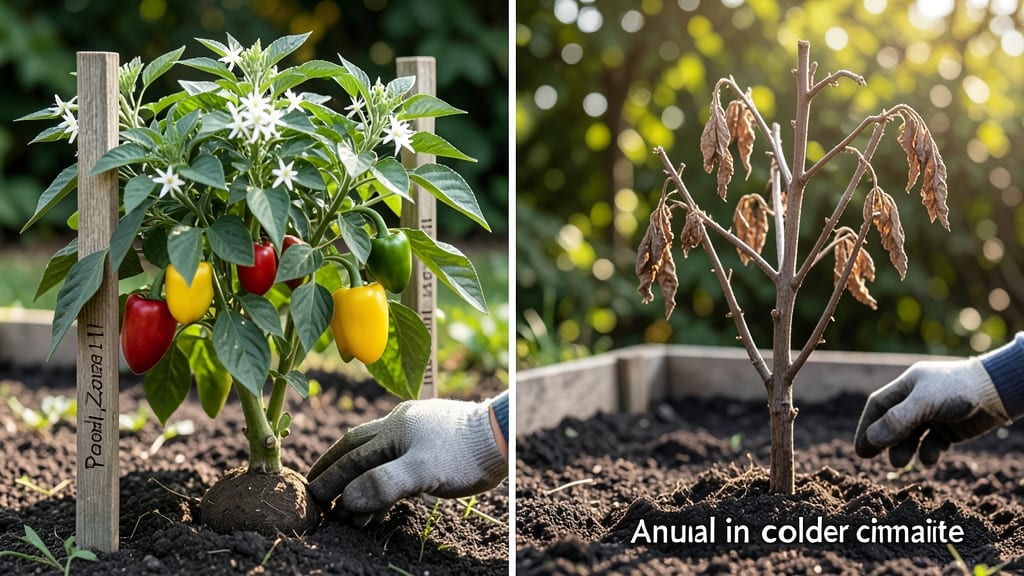
Pepper plants are not true perennials in most climates, dying back annually in frost but often regrowing from the roots if protected or replanted each spring. Their lifespan depends on temperature, care, and variety—some tropical types survive indoors year-round while others perish in cold weather.
Pepper plants behave like perennials in warm climates, but their hardiness varies dramatically with temperature. 🌱 Most garden varieties freeze to death when temperatures drop below 32°F, though their roots may survive underground to sprout again in spring.
Tropical pepper species, however, can thrive indoors year-round with proper lighting and humidity control. The key difference lies in their native growing zones—while some peppers evolved to handle mild winters, others simply can't tolerate frost at all.
For gardeners in colder regions, this means choosing between overwintering strategies or treating peppers as annuals. Many growers successfully replant seeds each spring, while others experiment with container growing to bring plants indoors before the first frost.
The right approach depends on your local climate zone and how much effort you're willing to invest in preserving your plants.
💡 In This Article
- Why Pepper Plants Die Back in Cold Climates
- Extending Pepper Plant Lifespan: Indoor vs. Outdoor Strategies
Why pepper plants die back in cold climates
Pepper plants originate from tropical regions where temperatures rarely drop below 50°F, making them highly sensitive to frost. When temperatures fall below 32°F, the plant's cellular membranes rupture due to ice crystal formation, causing irreversible damage to stems and leaves.
This biological response explains why most garden peppers look like they've "died" after winter—it's not just wilting, but actual cellular destruction. 🌡️
The roots, however, often survive because they're insulated by soil and organic matter, which can maintain temperatures 10-15°F warmer than the air above. This is why you sometimes see peppers regrowing from the base in spring—the roots were never truly dead, just waiting for warmer conditions.
The depth of root survival varies by variety, with some tropical types needing 6-8 inches of soil protection while hardier varieties might tolerate shallower coverage.
Climate zones play a crucial role in determining whether peppers act perennially. In USDA zones 10-12, peppers naturally behave like perennials, growing continuously year-round. But in zones 5-8, where winters drop below freezing, peppers become annuals unless actively protected.
The transition temperature where damage occurs is typically between 35-40°F—below this, even short exposures can be fatal to most varieties.
What most gardeners don't realize is that pepper plants have a built-in survival mechanism called "dormancy." When exposed to 50-55°F temperatures for extended periods, they enter a semi-dormant state where metabolic activity slows dramatically.
This explains why some peppers survive mild winters—even if they look dead, their roots may still be alive and capable of regrowth when conditions improve. 🌱
The key difference between true perennials and peppers lies in their growth cycles. Perennials like asparagus have specialized underground structures (rhizomes) that store energy year-round, while peppers rely on their root systems and surrounding soil for protection.
Without proper insulation, these roots can't sustain the plant through freezing temperatures, which is why mulching with 4-6 inches of straw or leaves becomes critical in marginal climates.
Interestingly, some pepper varieties have been selectively bred for cold tolerance, like the 'Armenian' or 'Hungarian Wax' types, which can handle brief exposures to 25°F without dying. These varieties demonstrate that while peppers aren't naturally perennial in cold climates, targeted breeding can extend their hardiness.
The science behind this involves selecting plants with thicker cell walls and higher concentrations of protective compounds like flavonoids.