
Vegetables
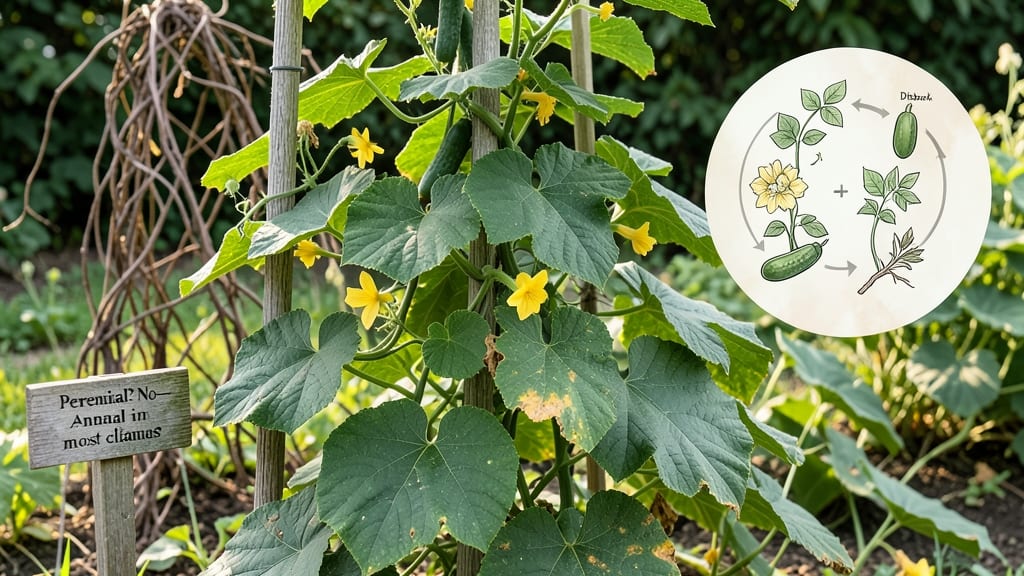
Cucumbers are not perennial—they are annual plants that complete their life cycle in one growing season, though some varieties may regrow from roots if conditions are ideal. Most gardeners replant them yearly for best yields.
Cucumbers might seem like they could return year after year, especially if you've seen them regrow in your garden. 🌱 This happens because their root systems can survive mild winters in temperate climates, tricking many into thinking they're perennial.
However, true perennials like asparagus or rhubarb regrow consistently because their crowns are hardier and adapted to survive freezing temperatures. Cucumbers, on the other hand, are tropical plants that thrive in warm weather and often die back completely in colder regions, requiring replanting each spring for reliable harvests.
If you're in a region with mild winters, you might still get some regrowth from cucumber roots, but this isn't the same as true perennial behavior. The key difference lies in their ability to withstand frost—cucumbers simply can't compete with plants that are genetically adapted to survive harsh winters.
For gardeners in colder zones, replanting is the safest way to ensure a full harvest every season.
💡 In This Article
- Why Cucumbers Act Like Perennials in Mild Climates
- Tips for Extending Cucumber Growth Beyond One Season
Why cucumbers act like perennials in mild climates
Cucumbers (Cucumis sativus) originate from tropical regions, where they thrive in warm, frost-free conditions. Their growth habit is fundamentally annual—they produce vines, flowers, and fruit within a single growing season (typically 60-70 days from seed to harvest).
However, their root systems can persist in mild winters (USDA zones 9-11), creating the illusion of perennial behavior. Unlike true perennials like asparagus, which develop specialized underground crowns designed to survive freezing temperatures, cucumbers rely on their fibrous root network to endure. 🌱
The confusion arises because cucumber roots can regenerate in spring if protected from hard freezes (below 28°F). In warmer climates, gardeners often observe new shoots emerging from the same spot year after year, leading to the misconception that cucumbers are perennial.
True perennials, such as rhubarb or strawberries, have dedicated storage organs (rhizomes, tubers) that remain dormant but viable through winter. Cucumbers lack these adaptations, making their regrowth dependent on environmental conditions rather than biological design.
Scientifically, this behavior stems from cucumbers' classification as "tender perennials"—a term used for plants that would be perennial in their native tropics but behave as annuals in colder regions. Their tropical heritage means they lack cold-hardiness genes found in native perennials.
For example, while asparagus crowns can withstand -20°F temperatures, cucumber roots typically die back below 32°F unless insulated by mulch or snow cover. This explains why gardeners in Florida might see cucumbers return annually, while those in Minnesota must replant every spring.
Another key factor is the plant's growth cycle. Cucumbers allocate energy to rapid vine growth and fruit production rather than root storage. When temperatures drop, their energy reserves are depleted, leaving them vulnerable to cold damage.
In contrast, perennials like artichokes store carbohydrates in their roots, allowing them to regrow robustly each spring. Cucumbers' survival strategy is purely opportunistic—they'll regrow if conditions permit, but they're not biologically equipped for consistent perennial behavior. 🌿
Consider this comparison: While a cucumber plant might produce 20-30 pounds of fruit in its first season, a true perennial like a fig tree can yield fruit for decades. The trade-off is clear—cucumbers prioritize short-term productivity over long-term survival.
This is why gardeners in temperate zones often see cucumbers "cheat" the system by regrowing, but never with the same vigor or consistency as dedicated perennials.