
Flowers
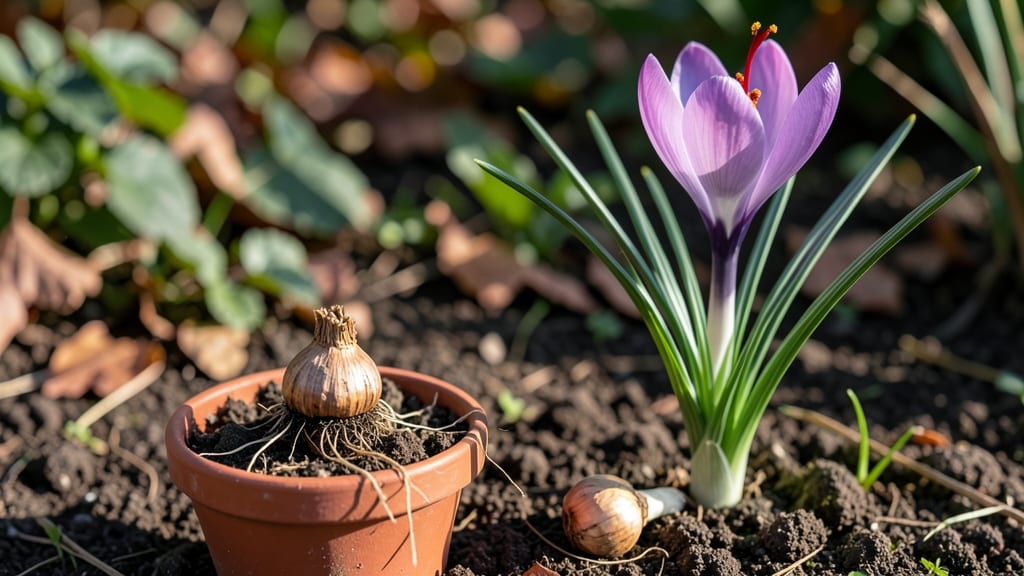
Saffron isn't a true perennial because its underground corms go dormant each year, but it reliably regrows from the same root system when given proper care—acting like a perennial in cultivation. Harvesting must be precise to prevent over-killing the plant.
Saffron's unique growth cycle comes from its crocus origins—while it loses its above-ground foliage annually, the corms (thickened underground stems) remain alive and can regenerate for 5-10 years with consistent care. 🌱 Unlike annuals that die completely, saffron's corms store energy for next season's regrowth, which is why many gardeners treat it as a long-term crop.
The key difference from true perennials is that saffron's foliage dies back completely each autumn, but the root system persists.
This semi-perennial behavior makes saffron ideal for patient gardeners who can commit to its specific needs. The plant thrives in well-draining soil and full sun, with careful watering to avoid rotting the corms during dormancy.
Many growers find that harvesting just 10-20% of stigmas per season maintains the plant's health while still producing valuable saffron.
💡 In This Article
- How Saffron’s Root System Functions Like a Perennial
- Cultivating Saffron as a Long-Term Garden Perennial
How saffron’s root system functions like a perennial
Saffron's semi-perennial nature stems from its specialized corm-based root system, which stores nutrients and energy between growing seasons. Unlike true perennials that maintain active roots year-round, saffron's corms enter dormancy after flowering, withstanding winter temperatures down to -10°F (-23°C) when properly mulched.
The corms—thickened underground stems—contain starch reserves that fuel regrowth each spring, similar to how tulip bulbs operate but with a more robust structure.
What sets saffron apart is its two-phase growth cycle: a 6-8 week active period in autumn when it produces flowers and foliage, followed by a 9-12 month dormancy where all above-ground growth dies back.
During dormancy, the corms remain alive but metabolically inactive, with moisture levels dropping to just 10-15% water content—a survival adaptation that prevents rot. This contrasts with true perennials like lavender, which maintain green foliage year-round through different mechanisms.
The regrowth process begins when temperatures rise above 50°F (10°C), triggering the corms to send up new shoots. Each corm can produce 1-3 flower stalks, each bearing 3-4 flowers that yield the prized stigmas.
The plant's ability to regenerate from the same corm for multiple years makes it behave like a perennial, though gardeners must avoid over-harvesting—removing more than 30% of stigmas in a season can weaken the corm's reserves for next year.
Saffron's corms also exhibit a unique clustering behavior over time. Each year, the mother corm produces 1-2 daughter corms (called "cormels"), which can be separated and replanted to expand the crop.
This natural propagation contrasts with bulbs like garlic, which don't produce offsets, and true perennials that rely on root systems rather than specialized storage organs. The corms' ability to regenerate makes saffron more resilient than annual crops but requires careful management to maintain vigor.
Climate plays a crucial role in this cycle. In Mediterranean climates where saffron originated, the cool, wet winters followed by warm, dry summers create ideal conditions for dormancy and regrowth.
In colder regions, gardeners must provide insulation with mulch or straw to protect corms during winter, while in hot climates, summer dormancy helps the plant survive temperatures up to 95°F (35°C) without irrigation.
This adaptability explains why saffron can be cultivated as a long-term perennial in diverse climates with proper care.
One fascinating aspect is how saffron's corms increase in size annually when conditions are optimal. A mature corm can reach 1.5-2 inches (4-5 cm) in diameter after 3-4 years, supporting more robust flowering.
This growth pattern mirrors true perennials that expand their root systems over time, though saffron achieves this through its specialized corm structure rather than fibrous roots. The plant's ability to store and reuse energy makes it an efficient crop for patient gardeners willing to invest in its long-term cultivation.