
Flowers
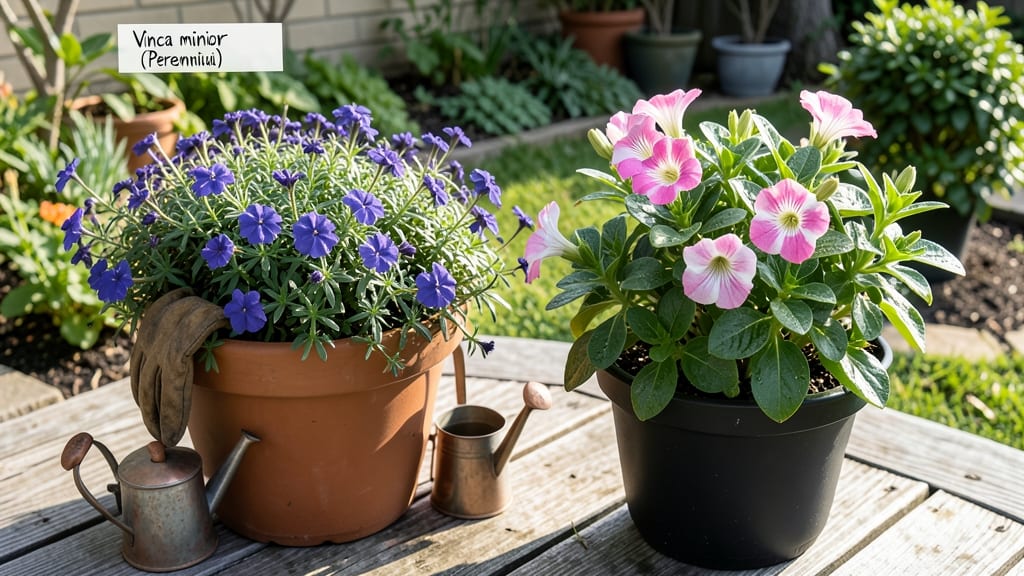
Determining whether vinca is annual or perennial depends on the variety and climate: vinca is a perennial that dies back in winter but regrows from its root system each spring, though it may behave like an annual in colder regions without proper care.
Vinca's true nature as a perennial becomes clear when you understand its underground survival strategy. 🌱 The plant's deep root system stores energy through winter, allowing it to push new growth once temperatures rise—typically by late spring.
However, if your region experiences harsh winters or if you don't provide winter protection (like mulch), the above-ground foliage may freeze completely, making it seem like an annual. This is why gardeners in USDA zones 5 and below often treat vinca as a tender perennial rather than a true annual.
What makes this even more interesting is how different vinca species handle cold. For example, Vinca minor (creeping myrtle) is hardier and often survives winters in zones 4-8, while Vinca major (greater periwinkle) tends to struggle in colder climates.
The key to keeping vinca perennial in your garden lies in proper winter care and selecting the right variety for your local conditions.
💡 In This Article
- Understanding Vinca’s Perennial Growth Cycle and Cold Hardiness
- Caring for Vinca to Ensure Year-Round Perennial Performance
Understanding vinca’s perennial growth cycle and cold hardiness
Vinca’s perennial nature relies on its specialized underground structure: a network of fibrous roots and shallow rhizomes that store carbohydrates and nutrients. These roots remain dormant but alive during winter, even when above-ground growth dies back completely.
The key mechanism here is the plant’s ability to photosynthesize and store energy in its roots during the growing season, which fuels regrowth when temperatures rise above 50°F in spring. This process is similar to how daylilies or peonies survive winter—through stored energy rather than persistent foliage.
The hardiness of different vinca species varies significantly based on their native habitats. Vinca minor, native to Europe and Asia, thrives in USDA zones 4-8, thanks to its cold tolerance down to -30°F when properly established.
In contrast, Vinca major, from the Mediterranean, typically struggles in zones colder than 7, where prolonged freezing can kill its roots. The difference lies in their evolutionary adaptations: Vinca minor developed thicker root systems to withstand colder winters, while Vinca major prioritized drought resistance over cold tolerance.
What causes vinca to appear annual in colder climates? The issue isn’t the plant’s biology but rather how gardeners interact with it. Without protective measures like a 3-4 inch layer of mulch or winter blankets, the roots can experience freeze-thaw cycles that damage their structure.
Even a single hard freeze below 20°F can kill back growth, making it seem like the plant died completely.
This is why many gardeners in zones 5 and below treat vinca as a short-lived perennial rather than a true annual—it’s not the plant’s fault, but rather a mismatch between its needs and the environment.
Consider the science of plant dormancy: vinca enters a state of winter dormancy when nighttime temperatures consistently drop below 45°F for several weeks. During this time, the plant conserves energy by slowing metabolic processes, much like how a bear hibernates.
The roots remain metabolically active enough to survive, but the above-ground parts shut down completely. This is why you’ll often see vinca regrow from the same spot year after year—it’s not starting fresh like an annual, but rather resuming from a dormant state.
Here’s a practical comparison: in zone 6, Vinca minor might survive winters with minimal protection, while Vinca major would likely die back completely without heavy mulching.
The difference in hardiness explains why some gardeners report vinca as annual in their region—what they’re seeing is the plant’s natural dieback cycle pushed to its limits by harsh winter conditions. The solution lies in understanding these biological mechanisms and adjusting care practices accordingly.
For example, in my own zone 5 garden, I’ve found that adding a layer of shredded leaves over the vinca bed in late fall provides the extra insulation needed to protect the roots.
By spring, the plants rebound with vigor, proving that vinca’s perennial nature is intact—it just needs the right conditions to thrive. 🌿