
Flowers
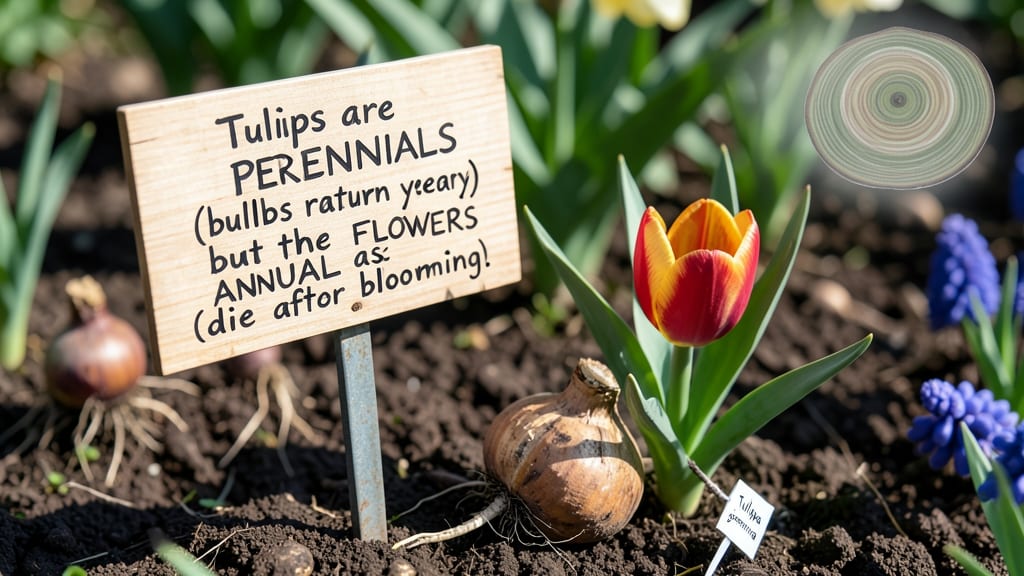
Are tulips annual or perennial? They're perennial plants that regrow yearly from their underground bulbs, though they often behave like annuals in colder climates without proper winter care and division every 3-5 years. Their hardiness depends on bulb health and seasonal conditions.
Tulips' perennial nature comes down to their bulbs, which store nutrients year-round to fuel regrowth. 🌱 When planted correctly in well-draining soil and given proper winter protection, these bulbs can survive for decades—but most gardeners need to divide them every 3-5 years to prevent overcrowding.
The key difference between annual and perennial behavior lies in how well you maintain those bulbs: neglect turns a reliable perennial into a one-season wonder.
In my experience, the biggest mistake gardeners make is assuming tulips are low-maintenance annuals. They're not—these plants demand attention to soil conditions, watering schedules, and seasonal care.
For example, leaving bulbs in soggy soil or skipping winter mulch in Zone 5+ climates will quickly turn your tulips into annuals, as the bulbs rot or fail to store enough energy for next year's blooms.
💡 In This Article
- Why Tulip Bulbs Determine Their Perennial Lifespan
- Extending Tulip Blooms: Perennial Care Tips for Gardeners
Why tulip bulbs determine their perennial lifespan
The perennial nature of tulips hinges entirely on their bulbs, which function like nature's energy banks. These underground structures store carbohydrates, proteins, and water—essentially fuel for next year's growth.
A healthy tulip bulb can contain up to 70% starch reserves, which convert to sugars during dormancy to power shoot emergence in spring. This biological mechanism explains why tulips can return yearly: their bulbs remain dormant but metabolically active, preserving energy until conditions improve.
What most gardeners miss is how bulb health degrades over time. Each growing season, the bulb divides and produces new shoots, but this process consumes stored nutrients.
After 3-5 years, the original bulb often exhausts its reserves, leading to smaller blooms or no flowers at all—a clear sign the plant is transitioning from perennial to annual behavior.
Overwatering or poor drainage accelerates this decline by promoting rot, while compacted soil restricts root development, further stressing the bulb's energy reserves. 🌱
The science gets even more interesting when you consider temperature. Tulip bulbs enter dormancy when nighttime temperatures drop below 50°F (10°C) for at least 6-8 weeks. This chilling period triggers hormonal changes that prepare the bulb for regrowth.
Without proper winter dormancy—common in warmer climates or when bulbs lack mulch protection—the bulbs may sprout prematurely or fail to store enough energy, effectively "forgetting" their perennial programming.
Regional hardiness zones play a critical role here. In Zone 3-5, tulips naturally overwinter, but in Zone 7+, gardeners must simulate dormancy by lifting bulbs or planting them in containers that can be moved.
The bulbs' ability to survive depends on their capacity to balance energy storage and consumption—a delicate act that explains why neglected tulips often behave like annuals despite their biological classification.
Consider this comparison: A well-cared-for tulip bulb in Zone 5 might produce 10-12 blooms its first year, then gradually decline over 5 years. But in the same conditions, a bulb that's overwatered or planted too shallow could flower only once before fading.
The difference lies entirely in how well the bulb's energy reserves are managed—a lesson in why tulips demand more attention than most gardeners realize. ✨
Here's what's actually happening underground: The bulb's basal plate (where roots emerge) contains meristem cells that divide during dormancy. Each division consumes stored starch, and without proper care, these cells exhaust their supply faster.
This cellular-level process explains why dividing bulbs every 3-5 years restores their perennial vigor—it's like giving the plant a fresh start with fully charged energy reserves. 💫