
Flowers
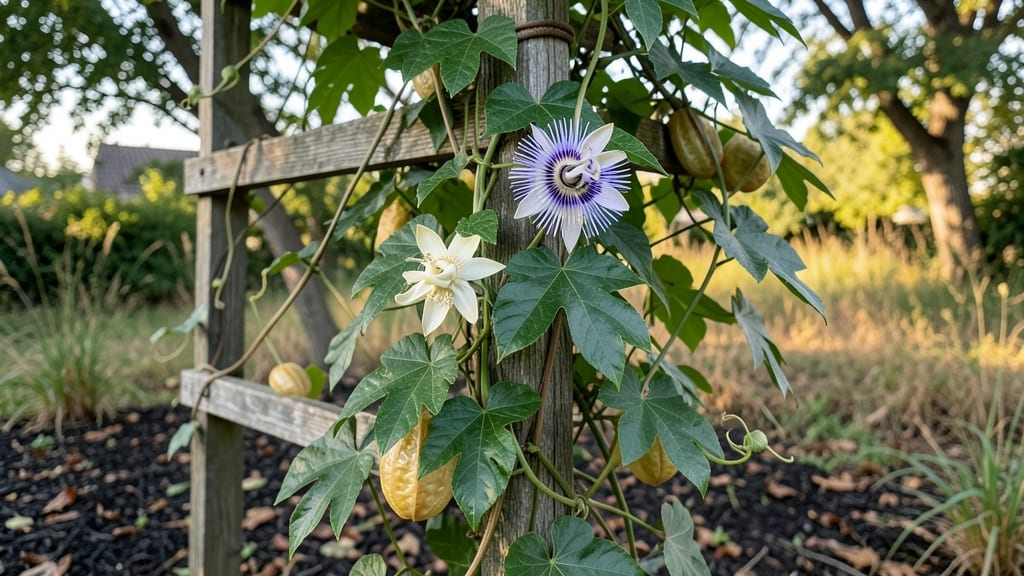
Passionflower acts as a perennial in warm climates but often dies back completely in colder regions, regrowing each spring from its roots when daytime temperatures consistently stay above 50°F.
This behavior stems from passionflower's tropical origins—it thrives where winters never drop below freezing. 🌱 The key difference is that while it may look dead in winter, its roots survive underground, ready to sprout when conditions improve.
In colder zones, gardeners can extend its perennial lifecycle by insulating the soil with thick mulch or growing it in containers that can be moved indoors during frost.
Think of it like a dormancy cycle: passionflower conserves energy during cold months, only to burst back to life when warmth returns. Many gardeners mistakenly assume it's an annual because they don't recognize these subtle survival cues.
The good news? With proper care, even in chillier climates, you can enjoy its stunning blooms year after year.
💡 In This Article
- Passionflower’s Perennial Nature Explained
- Growing Passionflower as a Perennial in Cool Climates
Passionflower’s perennial nature explained
Passionflower, scientifically known as Passiflora, is botanically classified as a perennial vine because its root systems persist year-round in ideal conditions.
This tropical/subtropical plant evolved in regions where winter temperatures rarely dip below 40°F, which means its natural lifecycle includes seasonal dormancy rather than complete death. 🌿 The confusion arises because many varieties exhibit winter dieback—losing their above-ground growth when exposed to frost—but their roots remain alive underground, ready to regenerate when warmth returns.
The key mechanism here is cold-induced dormancy, a survival strategy shared with other tender perennials like bougainvillea or hibiscus. When temperatures fall below 50°F for extended periods, passionflower's growth slows dramatically, and its leaves yellow and drop.
However, the root crown (the thickened base where roots and stems meet) stays protected beneath the soil, insulated by organic matter. This is why gardeners in USDA Zones 8-11 can treat it as a true perennial, while those in colder zones often see it behave like an annual.
What sets passionflower apart from hardy perennials is its sensitivity to freezing temperatures. Even a light frost can kill its tender stems and foliage, but the roots typically survive if they're at least 4 inches deep in well-draining soil.
This is similar to how canna lilies or elephant ears behave—they die back annually but regrow from their rootstocks. The difference is that passionflower's roots are less cold-resistant, making them more vulnerable to prolonged exposure below 32°F.
Consider this comparison: In Zone 10 (where winters rarely drop below 30°F), passionflower thrives as a perennial with minimal care.
But in Zone 6 (where winters average 0-10°F), the same plant might look dead by winter—yet if you dig down just 6 inches, you'll often find the root system still alive, waiting for spring.
This persistence is why some gardeners successfully overwinter passionflower by insulating the soil with 12+ inches of mulch or wrapping the base in burlap.
The science behind this involves abscission—the natural shedding of leaves and stems to conserve energy. Passionflower's cells produce ethylene gas in response to cold, triggering this process. Meanwhile, the root system enters a state of endodormancy, where metabolic activity slows to a crawl.
This dual mechanism allows the plant to "rest" during winter while keeping its foundational structure intact for next season's growth. 💫
For visual learners, imagine a passionflower vine in late fall: its vines may look brittle and brown, but beneath the soil, the roots resemble a network of thick, white fingers coiled in dormancy.
When spring arrives and soil temperatures reach 55°F, these roots begin producing new shoots within 2-4 weeks, proving the plant's perennial nature wasn't lost after all.