
Planting
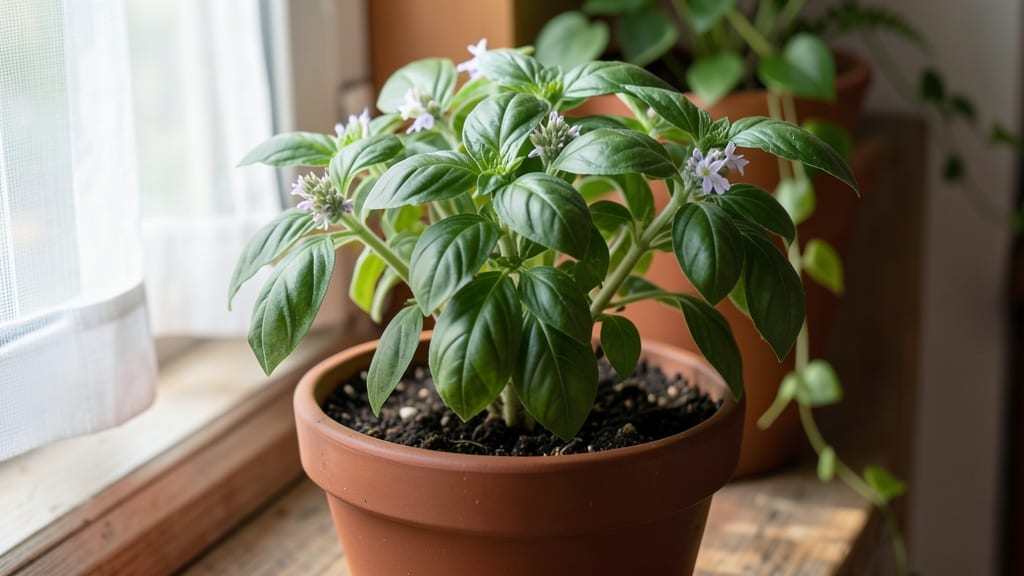
Basil is a perennial plant in frost-free zones but is commonly grown as an annual in cooler climates where it dies back with the first freeze. With proper care, it can regrow from roots or cuttings when temperatures warm again in spring.
Basil's classification depends entirely on your climate.
In USDA zones 10-11, where frost never touches the ground, basil thrives year-round as a tender perennial, sending up new growth after each harvest. 🌱 The key difference lies in its tropical origins—basil can't tolerate temperatures below 32°F, which is why most gardeners treat it as an annual in colder regions.
Even in mild winters, a light freeze will kill the plant back to the ground, though the roots often survive to regrow when conditions improve.
What many growers mistake for death is actually dormancy. The plant's woody stems may appear dead, but the root system often remains alive beneath the soil.
This is why you can often coax regrowth by cutting back the stems to 2-3 inches in early spring, provided the roots are still viable. The confusion arises because basil's perennial nature is only fully expressed in frost-free environments—anywhere with regular freezes will see it behave like an annual.
💡 In This Article
- Why Basil Dies in Cold Climates: The Science of Its Perennial Struggle
- How to Extend Basil’s Life: Overwintering and Regrowth Tips
Why basil dies in cold climates: the science of its perennial struggle
Basil's tropical origins explain why it struggles in cold climates. Native to regions like India and Southeast Asia, basil evolved in environments with consistent warmth and high humidity. Its cells lack the antifreeze proteins found in cold-hardy perennials like rosemary, which can survive 15-25°F temperatures.
When exposed to 32°F or below, basil's cell membranes rupture from ice crystal formation, killing the plant above ground. 🌡️ This is why even a single frost triggers what appears to be death in most growing zones.
The plant's growth habit also differs from true perennials. While rosemary develops woody stems that insulate its core, basil remains herbaceous with soft, non-woody stems that offer no protection against freezing. Its roots, however, can survive brief cold snaps if protected by mulch or soil insulation.
This explains why you might see regrowth in spring—what you're seeing is the plant's perennial root system re-emerging when temperatures rise above 50°F.
Another key factor is basil's photosynthetic efficiency. Unlike cold-hardy herbs, basil's leaves contain high levels of volatile oils that become damaged by frost, disrupting its ability to photosynthesize.
This is why you'll often see basil leaves turn black after a freeze—the oils oxidize and create a chemical reaction that kills the plant tissue. 🌿 In contrast, thyme and oregano can regrow from frozen stems because their essential oils are more frost-resistant.
Climate zones further illustrate this struggle. In USDA zones 10-11, where winter temperatures rarely dip below 40°F, basil behaves as a true perennial, growing continuously. But in zones 5-9, where winters drop below 20°F, basil dies back completely each year.
The confusion arises because basil's root crown (the base where stems emerge) can remain dormant underground for months, tricking gardeners into thinking it's truly annual.
What makes this especially interesting is how basil's growth cycle mirrors other tropical plants like mint or lemongrass. All three share similar cold sensitivity thresholds but differ in their ability to regenerate.
Basil's challenge lies in its slow root regrowth—unlike mint, which sends up shoots within weeks of warming, basil may take 4-6 weeks to show new growth, leading many to assume it's died permanently. 🌱
For comparison, consider rosemary's hardiness: it can survive -5°F because its leaves contain rosmarinic acid, which protects cell membranes. Basil lacks this chemical defense, making it far more vulnerable.
This fundamental difference in biochemistry explains why basil thrives as a perennial only in frost-free microclimates, like greenhouses or coastal areas where ocean currents moderate temperatures.