
Flowers
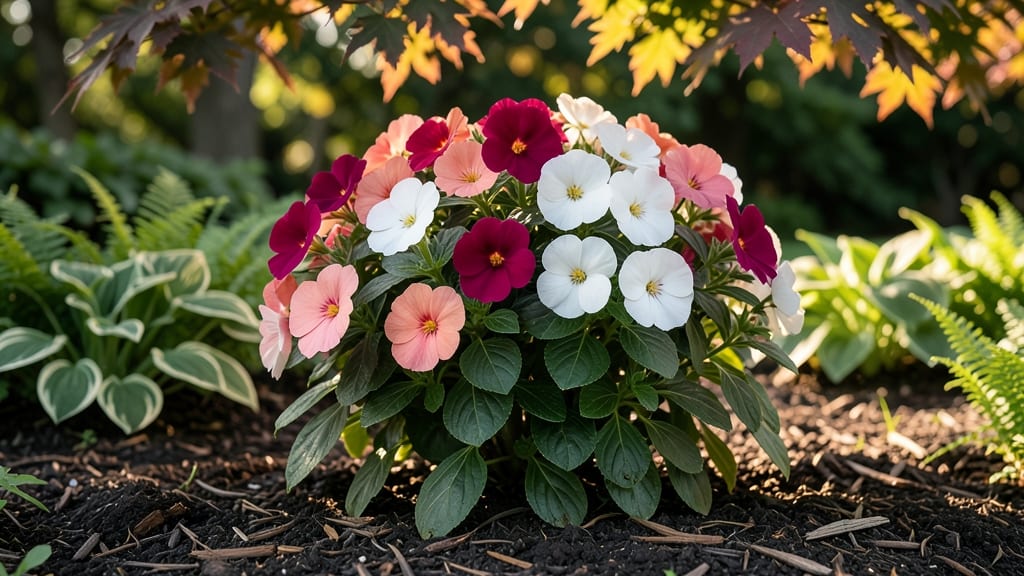
Whether impatiens flowers are annual or perennial depends on your climate: they act as annuals in cold regions because frost kills their tender stems, but they grow as perennials in tropical areas where temperatures stay above 50°F year-round. Their seasonal dieback in cooler zones is normal and doesn't indicate poor health.
This distinction comes down to their tropical origins—impatiens evolved where winters never drop below 50°F, so their stems and leaves simply can't tolerate frost. 🌱 In colder climates, they'll naturally die back to the ground each fall, but their roots often survive underground to sprout new growth in spring if conditions are right.
Many gardeners treat them as annuals simply because they're easier to replace each year rather than attempt overwintering.
What's fascinating is how their behavior shifts with microclimates: a sheltered spot in USDA Zone 7 might protect them enough to regrow, while an exposed garden bed in the same zone will likely see total dieback.
This is why you'll often find impatiens labeled as "tender perennials"—they're not cold-hardy like daylilies, but they're not true annuals either.
💡 In This Article
- Why Impatiens Die Back in Cold Climates
- How to Extend Impatiens Lifespan in Gardens
Why impatiens die back in cold climates
Impatiens' tropical heritage explains why they can't handle frost. Native to East Africa and Southeast Asia, these plants evolved in regions where temperatures rarely dip below 50°F. Their stems contain minimal lignin—a woody polymer that provides structural support in cold-hardy plants—which makes them vulnerable to freezing.
When temperatures drop to 32°F or lower, their cell walls rupture, causing irreversible damage to stems and leaves.
The real science lies in their cellular response to cold. Impatiens lack the ability to produce antifreeze proteins like some perennials do, which protect plant tissues from ice crystal formation.
Instead, their cells contain high concentrations of water, making them prone to frost damage. 🌡️ In tropical climates, their natural growth cycle continues year-round, but in colder zones, the first frost triggers a rapid breakdown of chlorophyll, turning leaves yellow and brown as nutrients are reabsorbed into roots.
This dieback isn't a disease—it's a survival mechanism. While the above-ground parts perish, the roots often remain viable underground, storing energy for potential regrowth. This is why you might see impatiens popping up again in spring if the roots survived.
The key difference between true annuals and impatiens is that annuals die completely, while impatiens retain their root systems unless temperatures drop below 20°F for extended periods.
What's fascinating is how their behavior varies by region. In USDA Zone 8, where winters rarely drop below 10°F, impatiens often regrow naturally each year. But in Zone 5, where winters can reach -15°F, they behave like true annuals.
This regional variation explains why some gardeners treat them as perennials while others plant them fresh each spring.
There's also a genetic component to their cold sensitivity. Most commercial impatiens (like Impatiens walleriana) were bred for vibrant blooms and disease resistance, not cold tolerance. Their delicate stems lack the protective bark layers found in cold-hardy perennials, making them particularly vulnerable to even light frosts.
This is why gardeners in marginal climates often choose more resilient varieties or implement protective measures.
Understanding this biological reality helps explain why impatiens thrive in containers—they can be moved indoors before frost. Their roots, which can survive 28°F for short periods, make overwintering possible with proper care.
This tropical-perennial behavior is what makes impatiens so fascinating—they're not quite annuals, not quite perennials, but something in between that responds dramatically to temperature shifts.