
Orchid Care
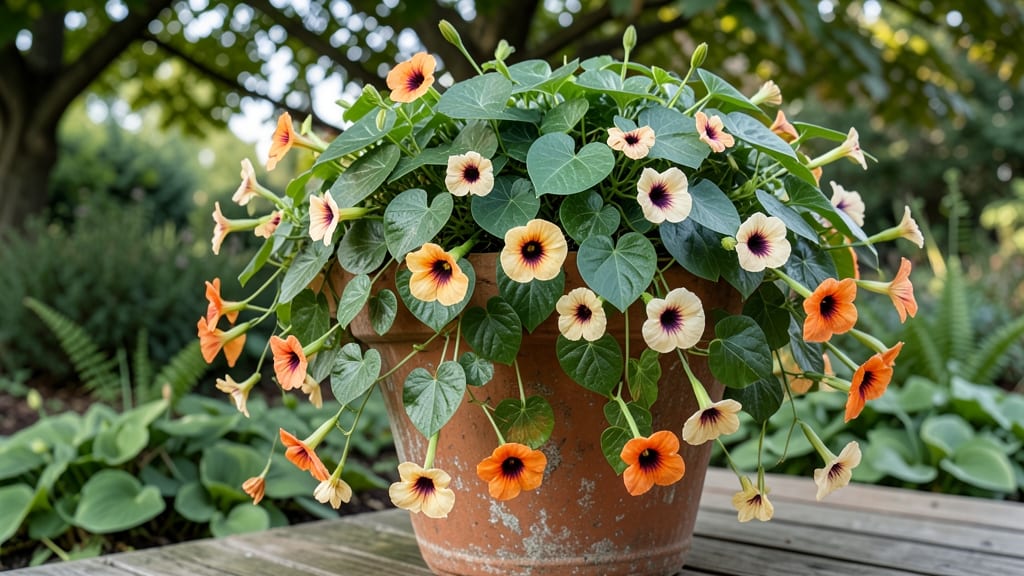
Deciding whether Black Eyed Susan Vine (Thunbergia alata) is annual or perennial depends on your climate: it thrives as a perennial only in frost-free zones (USDA 10-11) or when grown in containers and overwintered indoors. In cooler zones (3-9), it dies back with frost but reliably regrows from seed each spring.
This vine's behavior hinges on temperature sensitivity—its tropical origins mean it can't survive freezing temperatures. 🌱 In zones 3-9, frost kills the foliage, but the roots often persist underground until warm weather returns.
For container growers, bringing pots indoors during winter prevents complete die-off, effectively turning it into a perennial. The key is understanding your local frost dates and protecting the plant accordingly.
Many gardeners in cooler climates treat it as an annual, replanting fresh seeds each spring. However, with proper overwintering techniques—like insulating pots or mulching heavily—you can coax it back year after year. The secret lies in protecting the root system, which is surprisingly hardy once established.
💡 In This Article
- Why Black Eyed Susan Vine Dies Back in Cold Climates
- How to Extend Black Eyed Susan Vine’s Lifespan in Zones 3-9
Why Black Eyed Susan vine dies back in cold climates
Black Eyed Susan Vine (Thunbergia alata) originates from tropical regions, making it highly sensitive to freezing temperatures. Its natural range spans USDA zones 10-11, where winter temperatures rarely drop below 30°F.
When exposed to frost (32°F or lower), the vine's delicate foliage and stems quickly succumb to cold damage, turning black and crispy within hours. This is because the plant lacks the biochemical adaptations—like antifreeze proteins or deep root insulation—that hardy perennials develop in colder climates.
The vine's root system, however, often survives underground even in zones 3-9, provided the soil doesn't freeze solid. Roots can endure temperatures down to 20°F for short periods, especially if protected by mulch or organic matter.
What triggers the annual behavior isn't just frost itself, but the cumulative stress of repeated freeze-thaw cycles that weaken the roots over time.
In contrast, perennials like morning glories (Ipomoea) have evolved to regenerate from their root crowns even after severe cold, whereas Black Eyed Susan Vine relies more on seed viability for renewal.
Here's what happens at the cellular level: frost causes ice crystals to form in the vine's vascular tissues, rupturing cell walls and blocking water transport. This process, called cryoinjury, is irreversible in the above-ground parts but doesn't always kill the roots.
The plant's survival strategy shifts from maintaining foliage to preserving energy in its root zone until temperatures rise again. In warmer microclimates (like near south-facing walls), you might see partial survival of stems, but full regrowth typically requires new seeds or protected roots.
Temperature thresholds matter more than absolute zone numbers. For example, a 5°F dip in zone 7 might kill the vine completely, while the same temperature in zone 9 could be survivable with proper protection.
The vine's tropical nature means it lacks the cold-hardening process seen in temperate perennials, which gradually increase antifreeze compounds as temperatures drop. Without this adaptation, Black Eyed Susan Vine's annual cycle becomes its primary survival mechanism in cooler regions.
Consider this comparison: in frost-free zones, the vine grows continuously, producing flowers over multiple seasons. But in zones 3-9, it follows a monocarpic pattern—producing seeds once before dying back, then relying on those seeds for next year's growth.
This explains why many gardeners treat it as an annual: the energy invested in seed production leaves little reserve for overwintering. The key difference between annual and perennial behavior comes down to whether the plant can allocate resources to both flowering AND survival structures simultaneously.
One fascinating exception occurs in containers: when grown in pots, the entire root ball can be moved to a protected location (like a garage or insulated shed) during winter. This mimics the frost-free conditions of zones 10-11, allowing the vine to behave perennially.
The container's smaller volume means it cools down faster than in-ground plants, but proper insulation can maintain root viability through winter. This technique turns what would normally be an annual into a multi-year plant with minimal effort.