
Plants
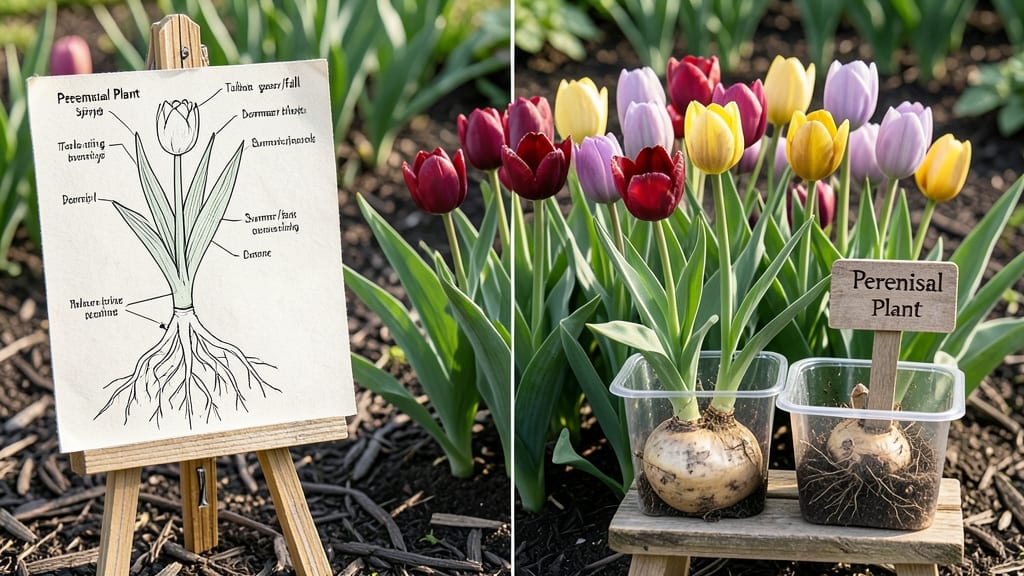
Tulips are not true perennial plants in most climates—their bulbs typically die back after flowering and require replanting yearly. However, in cold-hardy zones (3–7), they can return for 3–5 years with proper care before needing division or replacement.
Tulips often act like perennials because their bulbs store energy underground, allowing them to regrow each season—but this isn't the same as true perennial behavior. 🌱 Unlike daffodils or peonies, which reliably regenerate year after year, tulip bulbs gradually weaken after blooming, especially in warmer climates.
The key difference lies in their dormancy cycle: tulips need cold stratification to reset their growth pattern, which is why they thrive in colder regions.
In zones 3–7, you can extend their lifespan by planting bulbs at the right depth, using well-draining soil, and applying a thick layer of mulch to protect them through winter. Hybrid tulips often need more frequent division than species varieties, which are hardier.
The trick is balancing their love for cold with proper summer care—too much heat or moisture can exhaust the bulbs faster.
💡 In This Article
- Why Tulip Bulbs Act Like Perennials (But Aren’t)
- How to Extend Tulip Lifespan in Your Garden
Why tulip bulbs act like perennials (but aren’t)
Tulip bulbs store energy in specialized underground structures called tunicated bulbs, where layers of fleshy scales hold nutrients and moisture. This design allows them to survive winter dormancy and regrow in spring—mimicking perennial behavior.
However, unlike true perennials (such as daffodils or peonies), tulip bulbs don’t replenish their energy reserves efficiently after flowering. After blooming, they enter a phase called senescence, where the bulb gradually depletes its stored nutrients, weakening over time.
The critical difference lies in their cold stratification requirement. Tulips need 6–8 weeks of temperatures below 40°F to break dormancy and reset their growth cycle. Without this cold period, bulbs may produce fewer or no flowers the following year.
In warmer climates (zones 8+), this lack of cold exposure accelerates bulb decline, forcing gardeners to replant annually. Species tulips, like Tulipa tarda, are hardier and can survive longer than hybrid varieties, which often exhaust faster due to selective breeding for showy blooms.
True perennials, like Alliums or Hosta, regenerate from roots or rhizomes that continuously produce new growth. Tulips, however, rely entirely on their bulb’s stored energy.
After flowering, the leaves continue photosynthesizing for 6–8 weeks to replenish the bulb—but if you remove the foliage too early, you starve the bulb of its only chance to recover.
This is why many gardeners mistakenly think tulips are perennials: they can return for years, but only if given ideal conditions.
Another key factor is the bulb’s lifespan. In optimal cold climates (zones 3–7), a well-cared-for tulip bulb may last 3–5 years before needing division. However, each year, the bulb’s energy reserves shrink slightly, and the flowers may become smaller or less vibrant.
This gradual decline is why professional gardeners recommend dividing and replacing bulbs every 3–4 years, even in cold zones. The process involves lifting, separating, and replanting the bulbs to refresh their energy stores.
Consider this comparison: a daffodil bulb (true perennial) can divide naturally, producing offsets that form new bulbs over time. A tulip bulb, however, doesn’t reproduce in the same way—it simply weakens unless you intervene with proper care.
This is why hybrid tulips, bred for large, dramatic blooms, often require more frequent replacement than their wild counterparts, which have evolved to thrive with minimal intervention.
Here’s what’s actually happening underground: After flowering, the tulip bulb’s top layers (the scales) begin to dry out and shrivel, while the bottom layers store nutrients for next year.
If the bulb isn’t given enough time to recover—whether due to heat stress, poor soil, or early foliage removal—it won’t have enough energy to produce flowers the following spring. This biological limitation is why tulips are classified as short-lived perennials rather than true perennials.