
Plants
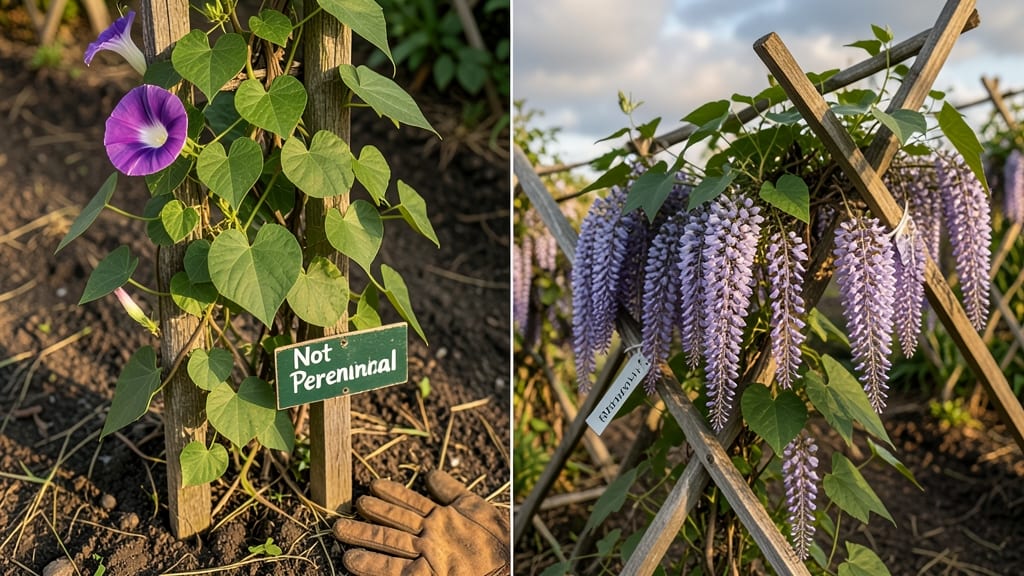
Morning glory plants behave like short-lived perennials in many climates because their underground tubers regrow seasonally if conditions remain stable and undisturbed.
Morning glories aren't true perennials because they lack the hardy root systems of plants like hostas or peonies. Instead, their underground tubers act as storage organs that survive winter dormancy in mild climates. 🌱 The key difference?
True perennials regrow from the same root system year after year, while morning glories rely on these tubers to sprout fresh shoots annually. This makes them "short-lived perennials"—reliable for 2-3 years if conditions are ideal, but vulnerable to cold snaps or soil disturbances.
In colder regions, these tubers often freeze, requiring replanting each spring. Even in warmer zones, their lifespan depends on soil health and winter protection. Understanding this helps gardeners decide whether to dig up tubers for overwintering or leave them in place with mulch for natural regrowth.
💡 In This Article
- How Morning Glory Tubers Influence Plant Longevity
- Tips for Encouraging Morning Glory Regrowth Year After Year
How morning glory tubers influence plant longevity
Morning glory tubers function like nature's built-in survival kit, storing nutrients and energy to fuel regrowth each season. These thickened underground stems—often resembling small, knobby potatoes—contain starches and sugars that sustain the plant during dormancy.
Unlike true perennials with deep root systems, morning glory tubers rely on this stored energy to sprout fresh shoots when conditions warm up. 🌱 The tuber's size matters too: larger tubers (typically 1-3 inches in diameter) produce more vigorous plants, while smaller ones may struggle in harsh winters.
The cold hardiness of these tubers varies dramatically by species. Sweet potato morning glories (Ipomoea batatas) can survive down to 20°F with proper mulching, while common morning glories (Ipomoea purpurea) usually die back in temperatures below 30°F.
This explains why they're not true perennials in temperate zones—their tubers often freeze or rot during winter. Even in mild climates, tuber lifespan averages just 2-3 years without human intervention, as they gradually deplete their stored reserves each season.
What makes morning glories unique is their ability to produce multiple tubers from a single plant. Each vine can generate 5-10 tubers per season, creating a network of potential regrowth points. This adaptation explains why disturbed plants often resprout from nearby tubers—even if the main plant is removed.
However, this same trait makes them vulnerable to digging or soil cultivation, which can sever tuber connections and reduce next year's growth potential.
The tuber's location also plays a critical role. Most morning glory tubers form 4-6 inches below the soil surface, where temperatures remain more stable. In colder regions, this depth provides some protection, but it's not enough to guarantee survival through freeze-thaw cycles.
The tuber's moisture content is another key factor—too dry and it shrivels; too wet and it rots. This delicate balance explains why gardeners in marginal climates often need to take active steps to protect these storage organs.
Consider the case of Ipomoea nil, the moonflower variety. Its tubers are particularly sensitive to cold, often requiring 10-12 weeks of warm soil temperatures to regrow. This explains why moonflowers frequently behave as annuals in northern gardens—even though they're technically capable of tuber-based regrowth.
The plant's evolutionary trade-off is clear: prioritize rapid above-ground growth for seed production over long-term tuber survival in unpredictable climates.
For gardeners, understanding this tuber biology reveals why morning glories often disappear after one season in colder regions. The tubers may still be present but too damaged to regrow effectively.
This is where human intervention—like proper mulching or tuber storage—can transform these plants from annuals into reliable short-lived perennials in your landscape. 💫