
Flowers
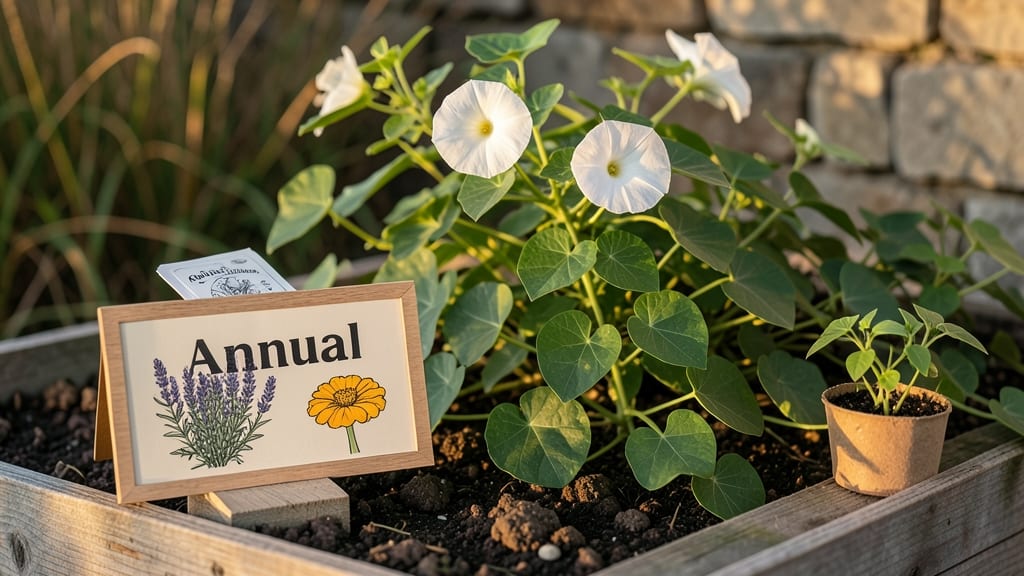
Moonflowers are not perennials—they die back completely after blooming and do not regrow from the same roots each year, classifying them as tender annuals in most climates. Their fast life cycle and self-seeding behavior create the illusion of returning growth annually, but the original plant does not survive winter.
Moonflowers may look like they come back every year, but their behavior is actually a clever survival strategy. 🌙 These plants thrive in warm climates and complete their entire life cycle—from seed to bloom to seed—within just a few months.
Once frost hits, their stems and leaves wither completely, leaving only the roots to die back. What appears as "returning" growth is actually new seedlings sprouting from seeds dropped the previous season, not the same plants regrowing.
This rapid life cycle makes them perfect for short growing seasons, but it also means they can't withstand freezing temperatures like true perennials. Unlike plants that store energy in roots or rhizomes to regrow each spring, moonflowers rely entirely on their seeds to continue the next generation.
That's why gardeners often see them pop up year after year—they're not the same plants, just their offspring!
💡 In This Article
- Why Moonflowers Act Like Annuals Despite Self-Seeding
- How to Grow Moonflowers Year After Year
Why moonflowers act like annuals despite self-seeding
Moonflowers (Ipomoea alba) follow a biological strategy called monocarpic annuality, meaning they complete their entire life cycle—from seed germination to flowering, seed production, and death—in just one growing season.
Their shallow root systems (typically only 6-12 inches deep) lack the energy reserves needed to survive winter dormancy like true perennials. When temperatures drop below 32°F, their cells rupture due to ice crystal formation, killing the entire plant structure above and below ground.
This frost sensitivity is their defining trait as annuals.
The rapid life cycle is another key factor—moonflowers can sprout from seed, bloom, and produce viable seeds in as little as 60-90 days in warm climates. Their large, white flowers (up to 5 inches wide) open at night to attract moth pollinators, ensuring efficient seed production before the first frost.
Unlike biennials that store energy for two years or perennials that regrow from roots, moonflowers allocate all their resources to reproduction in a single season, leaving nothing to sustain overwintering.
What creates the illusion of perennial behavior is their prolific self-seeding. A single moonflower plant can drop 1,000-2,000 seeds that remain viable in soil for up to 3-5 years.
When spring warmth triggers germination, these new seedlings emerge, creating dense colonies that make it seem like the original plants returned. This strategy is actually a survival adaptation for unpredictable climates—it ensures genetic continuity even if individual plants don't survive winter.
Compare this to true perennials like peonies, which develop thick underground rhizomes storing 20-30% starch reserves to fuel regrowth each spring. Moonflowers have no such storage mechanism—their roots contain minimal energy reserves (5% starch max) and decompose completely after frost.
The confusion arises because their self-seeding creates multi-year displays, but each generation is biologically distinct from the last.
Climate plays a crucial role in this behavior. In USDA zones 9-11, moonflowers may persist year-round without frost damage, but even there they're technically annuals—they complete their cycle each year rather than maintaining continuous growth.
In colder zones (7 and below), they behave as classic annuals, requiring replanting or relying on seed banks for next year's growth. This climate-dependent behavior explains why gardeners often see them "return" annually despite their biological classification.
Here's what happens at the cellular level: Moonflowers lack the antifreeze proteins found in true perennials, which prevent ice crystal formation in plant tissues. Instead, their cells contain high concentrations of proline and glycinebetaine—osmolytes that help maintain membrane integrity during drought but offer no protection against freezing.
When temperatures drop below 30°F, these protective compounds fail, leading to rapid cellular dehydration and death.