
Flowers
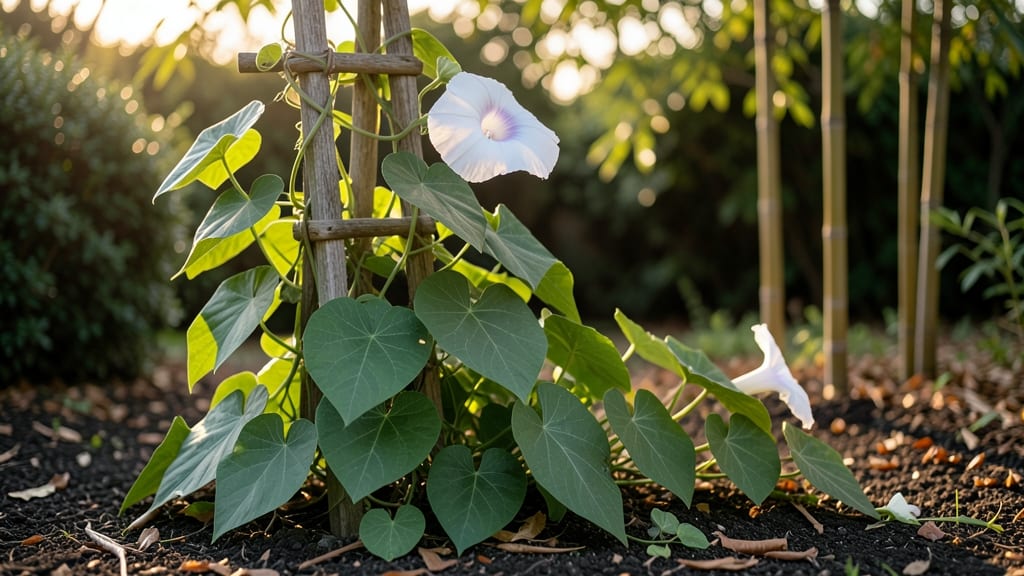
Moon flowers aren't true perennials in most climates—they die back after frost but reseed prolifically, returning each year as self-sustaining volunteers unless disturbed. Their survival depends on winter hardiness and seed viability rather than persistent roots.
Moon flowers (Ipomoea alba) behave like annuals because their tubers and stems can't survive freezing temperatures. 🌱 Once frost hits, the entire plant collapses, but if seeds remain undisturbed in the soil, they'll sprout again the following spring.
This explains why they're classified as tender perennials—they thrive in warm climates but act like annuals in colder zones. The key difference is their reliance on seed germination rather than root persistence to continue growing year after year.
What makes this interesting is how adaptable moon flowers are. In regions with mild winters, they might actually persist through the season, but in most of the U.S., gardeners treat them as annuals that magically reappear.
This self-seeding behavior is what keeps them coming back, making them a low-maintenance choice for summer gardens.
💡 In This Article
- Why Moon Flowers Act Like Annuals in Cold Climates
- How to Extend Moon Flower Growth Beyond One Season
Why moon flowers act like annuals in cold climates
The confusion about moon flowers stems from their botanical classification as tender perennials. Unlike hardy perennials (such as peonies or hostas), moon flowers (Ipomoea alba) have delicate tubers and stems that lack the cold resistance to survive freezing temperatures.
When nighttime temperatures drop below 32°F, the plant's cellular structure freezes, causing irreversible damage to the vascular system that transports water and nutrients. This is why the entire plant wilts and dies back to the ground—it's not entering true dormancy like true perennials.
What sets moon flowers apart is their seed viability rather than root persistence. The plant's seeds contain a hard outer coating that protects the embryo from drying out, allowing them to remain dormant in the soil for years until conditions are favorable.
In warmer climates (USDA zones 9-11), the tubers may survive mild winters, but in most of the U.S., frost kills the above-ground growth completely.
The seeds, however, can lie dormant through winter and germinate again in spring, creating the illusion of a self-sustaining annual cycle. 🌱 This explains why moon flowers often appear to "come back" without any gardener intervention.
The key mechanism here is temperature-triggered dormancy. When temperatures rise above 50°F in spring, the seeds absorb moisture and begin germinating. The plant then grows rapidly through summer, producing those iconic white, moon-shaped flowers that bloom at night.
Unlike true perennials that regrow from established roots, moon flowers rely entirely on this seed bank for regeneration. This makes them behave like annuals in colder climates, where winter survival rates drop to nearly 0% for the plant's vegetative structures.
Another critical factor is the plant's native habitat. Moon flowers originate from tropical and subtropical regions, where they're accustomed to consistent warmth. Their biological adaptation involves prioritizing seed production over winter hardiness—a survival strategy that works perfectly in their natural environment but creates challenges for gardeners in temperate zones.
The trade-off is that this seed-based lifecycle makes moon flowers incredibly resilient in disturbed soils, as they can quickly repopulate areas where other plants might struggle.
For gardeners, this means moon flowers will reliably return each year only if the seeds remain undisturbed in the soil. Any tilling, digging, or heavy foot traffic can destroy the seed bank, preventing new plants from emerging.
This is why moon flowers often thrive in neglected corners of gardens or along fences—areas where the soil is left undisturbed. The plant's ability to self-seed prolifically is what makes it such a popular choice despite its technical classification as a tender perennial.
Understanding this lifecycle helps explain why moon flowers are sometimes called "self-sowing annuals." While they're not true annuals (since they can persist through multiple growing seasons in ideal conditions), their behavior in most gardens mirrors that of annuals due to winter dieback.
This dual nature is what makes them so fascinating—and so low-maintenance—for summer gardens. ✨