
Plants
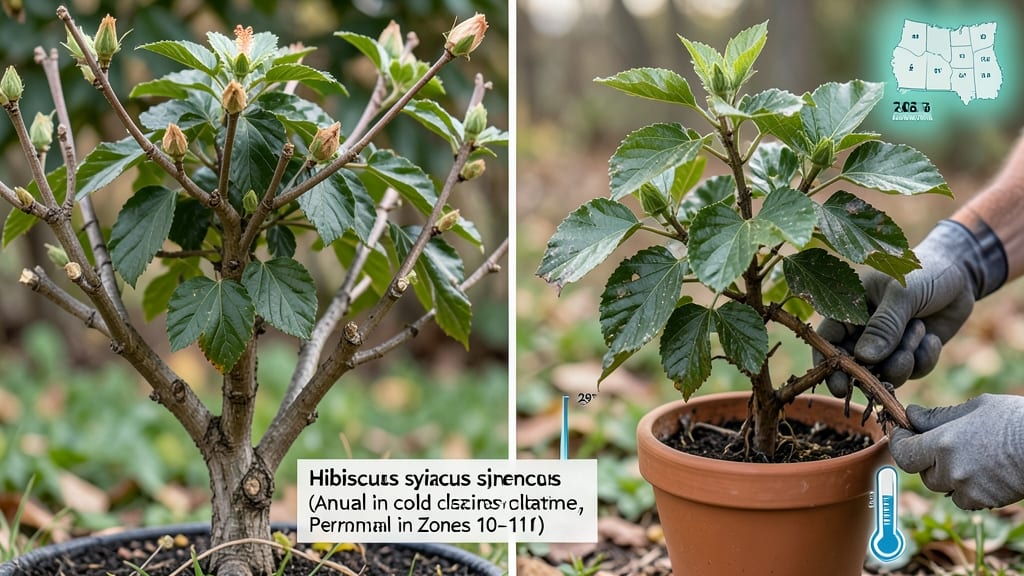
Hibiscus plants are perennials in warm climates but often treated as annuals in colder regions, where freezing temperatures kill them back to the ground. Hardy varieties can regrow from roots in spring with proper winter protection.
Whether hibiscus thrive as perennials or annuals depends entirely on your local climate. 🌡️ In frost-free zones (like USDA zones 9-11), tropical hibiscus naturally return each year from their robust root systems, blooming with the same vigor.
However, when temperatures dip below 20°F, even the hardiest varieties succumb to frost damage above ground.
The key difference lies in root hardiness—some cold-tolerant species (like Hibiscus moscheutos) survive winters in zones 5-8 when properly protected, while tropical types (like Hibiscus rosa-sinensis) rarely make it through freezing conditions without intervention.
This explains why gardeners in colder regions often replant hibiscus annually—they're not true annuals, but their top growth dies back completely. The roots remain dormant underground until spring, waiting for warmer soil temperatures to trigger regrowth.
Think of it like a plant version of hibernation: with the right winter care, even "annual" hibiscus can bounce back stronger than ever.
💡 In This Article
- Hibiscus Plant Lifespan: Climate and Variety Factors
- Winterizing Hibiscus for Cold-Climate Survival
Hibiscus plant lifespan: climate and variety factors
The distinction between perennial and annual hibiscus growth hinges on two critical factors: your local USDA hardiness zone and the specific hibiscus species. Tropical hibiscus (Hibiscus rosa-sinensis) thrives as a true perennial only in zones 9-11, where winter temperatures never drop below 20°F.
In these frost-free environments, the plant's deep root system stores enough energy to fuel spring regrowth without any human intervention. The roots can extend 3-5 feet deep, accessing moisture and nutrients year-round.
Contrast this with hardy hibiscus varieties like Hibiscus moscheutos (swamp hibiscus) or Hibiscus syriacus (rose of Sharon), which naturally survive winters in zones 5-8. These species have evolved thicker stems and more insulated root crowns that can withstand temperatures down to -15°F.
The key difference lies in their cellular structure—hardy varieties produce more suberin, a waxy substance that protects against moisture loss and cold damage during dormancy. 🌱 This biological adaptation explains why some hibiscus appear to "die" in winter only to return stronger the following season.
What most gardeners don't realize is that even tropical hibiscus contain dormant buds at their root crowns. When soil temperatures reach 55°F in spring, these buds receive hormonal signals to break dormancy.
The challenge in colder climates isn't the roots' ability to survive—it's protecting the 5-10 feet of above-ground growth that freezes solid. This is why proper winter protection transforms what appears to be an annual into a long-lived perennial.
Consider the case of Hibiscus moscheutos in zone 6: when properly mulched with 6-8 inches of organic matter, these plants can live for 20+ years, producing dramatic 6-8 inch blooms each summer.
The root system remains active year-round, slowly building reserves even during winter dormancy. This contrasts sharply with tropical hibiscus in zone 5, which typically survive only 2-3 years without careful winter care.
The science behind this survival mechanism involves a process called "cold acclimation." As temperatures drop, hibiscus plants increase their production of cryoprotective proteins that prevent ice crystal formation in their cells.
Hardy varieties can tolerate 30-40% ice content in their tissues without damage, while tropical types begin suffering irreversible cell rupture at just 10% ice content. This biological difference explains why some hibiscus varieties can regrow from roots after -10°F exposure while others require 20°F protection.
For gardeners in marginal zones (like zone 7), the choice between perennial and annual treatment often comes down to one factor: how much winter protection you're willing to provide.
A hibiscus that receives 3 inches of mulch might survive -5°F temperatures, while one with 6 inches of mulch plus burlap wrapping could handle -15°F. This flexibility means hibiscus can bridge the gap between perennial and annual classifications depending on your winter care routine.