
Plants
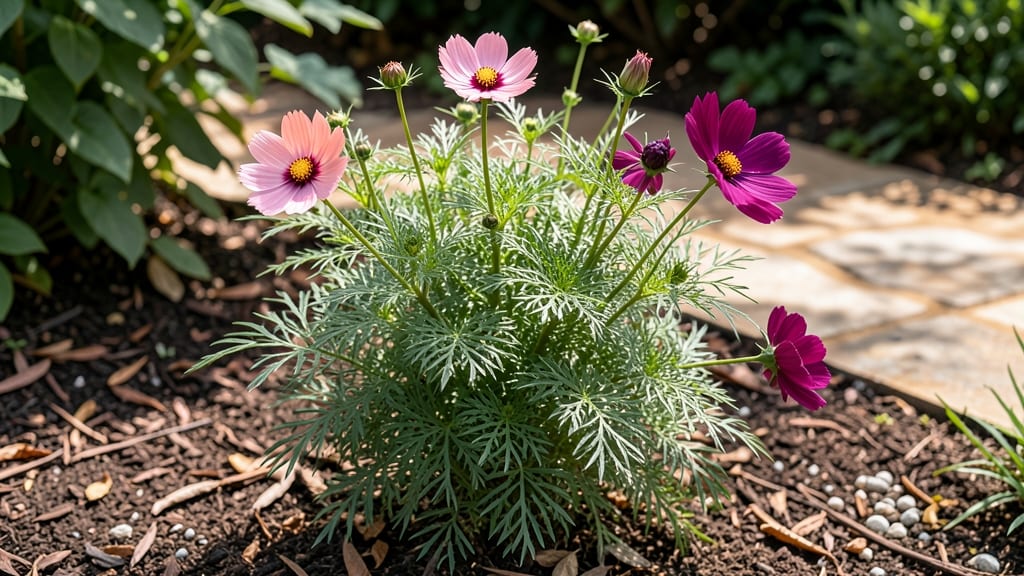
Cosmos plants are not perennial in most climates, as they typically die back after frost and do not regrow from the same roots. However, in USDA Zones 9-11, they may survive mild winters as tender perennials, often self-seeding prolifically instead of returning from the same plant.
Most gardeners treat cosmos as annuals because their delicate roots can't withstand freezing temperatures—once frost hits, the entire plant collapses. 🌱 The good news is that in warmer climates (Zones 9-11), they can persist through winter as tender perennials, though they rarely return from the same root system.
Instead, they rely on prolific self-seeding to repopulate each spring, creating natural drifts of color that require minimal effort from you.
This behavior differs from true perennials like coneflowers or black-eyed Susans, which regrow from established roots each year. Cosmos' survival strategy makes them perfect for gardeners who want low-maintenance blooms but don't want to deal with winter dieback in colder regions.
💡 In This Article
- Why Cosmos Die Annually in Most Climates
- How to Extend Cosmos Growth Beyond One Season
Why cosmos die annually in most climates
Cosmos plants belong to the Asteraceae family and are classified as tender annuals in most growing zones. Their inability to survive winter stems from a shallow, fibrous root system that lacks the protective insulation of deeper, woody roots found in true perennials like coneflowers (Echinacea).
When temperatures drop below 28°F, the delicate cell membranes in cosmos roots rupture, causing irreversible damage. This is why even a light frost (32°F) triggers complete plant collapse—unlike hardy perennials that enter dormancy and regrow from protected crowns.
The botanical mechanism behind this fragility lies in their rapid growth cycle. Cosmos complete their life cycle in just 90-120 days, prioritizing seed production over root development. Their stems contain 30-50% water content, making them particularly vulnerable to freeze-induced dehydration.
For comparison, established perennials like black-eyed Susans (Rudbeckia) can survive -20°F winters because their roots store carbohydrates and moisture, while cosmos have no such reserves. 🌱
What makes this particularly frustrating for gardeners is how cosmos often look perfectly healthy until the first frost hits. Their vibrant pink, white, or magenta blooms can still be producing seeds while underground roots are already compromised.
Unlike biennials that develop storage roots in their first year, cosmos allocate all energy to above-ground growth, leaving nothing to protect their roots from winter's chill. This is why even mulching 2-3 inches of straw won't save them in Zone 5 or colder climates.
The key difference between cosmos and true perennials becomes clear when examining their cambium layer—the growth tissue responsible for yearly regrowth. Perennials have a thick cambium that remains active through dormancy, while cosmos lack this protective layer entirely.
This is why you'll never see cosmos regrow from the same root system after winter, even in marginal zones where temperatures rarely drop below 25°F. Their survival strategy relies entirely on prolific seed production rather than root persistence.
Interestingly, cosmos exhibit a fascinating adaptation called thermomorphogenesis, where they grow taller and more spindly as temperatures rise—a trait that helps them escape competition but also makes them more susceptible to frost damage.
Their stems can reach 3-5 feet tall in ideal conditions, but this vertical growth comes at the expense of root development. This biological trade-off explains why cosmos thrive as annuals in most climates but struggle to establish perennial habits. 💫
For gardeners in transitional zones (6-8), this means cosmos will often self-seed prolifically after dying back, creating natural colonies that appear perennial—but this is actually a new generation of plants rather than the original roots returning.
The confusion arises because these new seedlings emerge from seeds dropped the previous year, not from surviving parent plants. This is why cosmos gardens can look continuous year after year without any actual perennial behavior.