
Plants
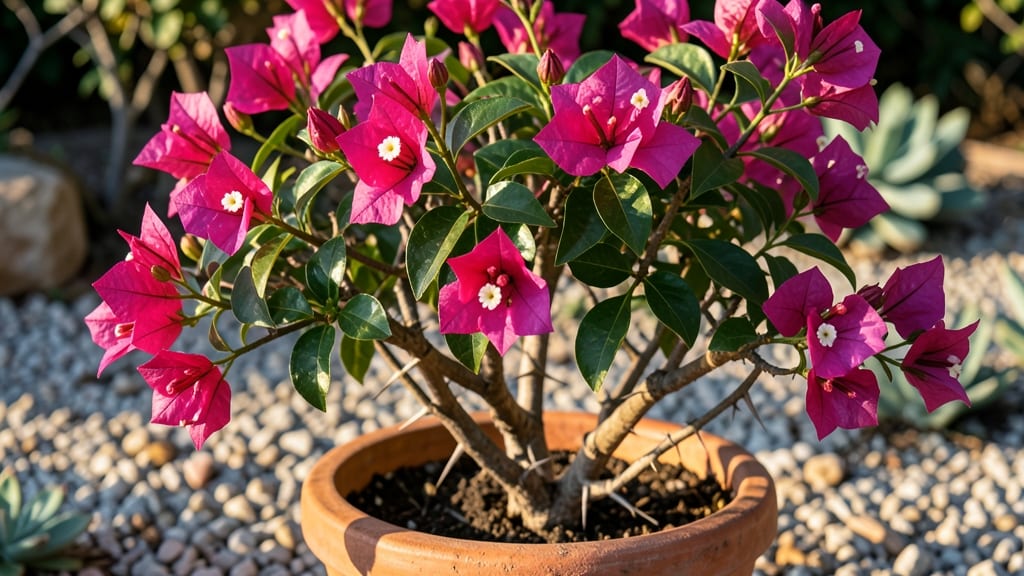
Bougainvillea plants are not naturally perennial in cold climates, thriving only as annuals or tender perennials in USDA Zones 9-11. In colder regions, they die back to the ground but can be regrown from cuttings or tubers each spring. Mulching and winter protection extend their lifespan in marginal zones.
Bougainvillea plants are tropical natives, so their perennial status depends entirely on your climate.
In warmer zones (9-11), they grow year-round, but in colder areas, they go dormant when temperatures drop below 30°F. 🌡️ The key difference is their ability to survive winter—where true perennials like roses regrow from the roots, bougainvilleas reset every spring from cuttings or stored tubers.
This makes them behave more like annuals in frost-prone regions, even though they're technically tender perennials.
What's fascinating is how their growth habits shift with temperature. In the deep south, they bloom continuously, while in cooler zones, they focus energy on root development before dormancy.
This adaptability is why gardeners in Zones 8 and below treat them as seasonal plants, often digging up tubers or overwintering cuttings indoors.
💡 In This Article
- Understanding Bougainvillea’s Perennial Nature in Different Climates
- Extending Bougainvillea’s Lifespan in Cold Regions
Understanding bougainvillea’s perennial nature in different climates
Bougainvillea's perennial status isn't fixed—it's a climate-dependent survival strategy. In USDA Zones 9-11, where winter temperatures rarely drop below 30°F, these tropical plants behave as true perennials, growing continuously with minimal dormancy.
Their thick, succulent-like stems store water and nutrients, allowing them to push through mild winters without significant damage. This is possible because bougainvillea's native habitat in South America's highlands evolved with seasonal dry periods rather than freezing temperatures.
The real magic happens in their growth adaptation mechanisms. When nighttime temperatures dip below 50°F for extended periods, bougainvillea triggers a natural dormancy response similar to deciduous trees.
Unlike true perennials that regrow from established root systems, bougainvillea shifts its energy to preserving its most critical parts—the root crown and upper stem nodes.
These nodes contain meristematic tissue capable of regenerating new growth when temperatures rise again in spring. 🌱 This biological reset explains why gardeners in colder zones can successfully regrow bougainvillea from cuttings each year.
Here's where the science gets interesting: bougainvillea's flowering response is directly tied to temperature fluctuations. In their native tropical environment, they bloom continuously when days are warm and nights are mild. But in temperate climates, the plant conserves energy for survival rather than reproduction during winter months.
This is why you'll often see bougainvillea in colder zones producing fewer blooms—it's prioritizing root development over floral display until conditions stabilize in spring.
The critical temperature threshold for bougainvillea's survival is 28°F. At this point, cellular damage begins as ice crystals form in the plant's vascular system, disrupting water transport.
The papery bracts that give bougainvillea its vibrant colors are particularly vulnerable to frost damage, which is why you'll often see them turning brown and crispy after a hard freeze.
In contrast, the woody stems can survive slightly colder temperatures, which is why gardeners focus on protecting these parts during winter.
What makes bougainvillea unique compared to other tropical plants is their ability to regenerate from multiple points. While many tropical plants die completely when exposed to frost, bougainvillea can often recover from as little as a 6-inch stem segment with several nodes.
This regenerative capacity means that even if the plant appears completely dead after winter, there's often still life in the root crown or protected stem sections waiting to sprout new growth when temperatures warm.
Consider this comparison: In Florida (Zone 10), bougainvillea grows as a vigorous, flowering perennial with minimal winter care. But in Georgia (Zone 8), the same plant might die back completely each winter, requiring gardeners to either dig up and store tubers or take cuttings indoors.
This dramatic difference in growth habits demonstrates how bougainvillea's perennial nature is more about adaptability than inherent hardiness.