
Planting
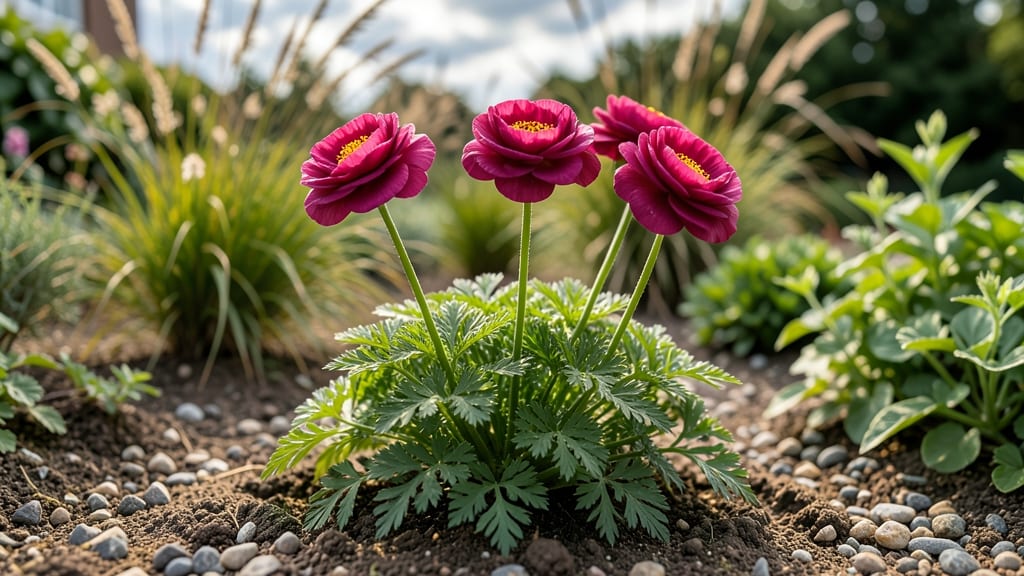
Ranunculus plants thrive as perennials only in USDA zones 8-10, where winter temperatures rarely drop below 20°F. In colder regions, their tuber roots struggle to survive frost, though varieties like Ranunculus asiaticus may persist with heavy mulch or greenhouse protection.
Most gardeners in zones 5-7 treat ranunculus as annuals because their delicate tubers lack the cold resistance of true perennials like peonies. 💫 The key difference lies in their growth cycle: while peonies store energy underground year-round, ranunculus tubers enter dormancy and require consistent soil temperatures above 40°F to regrow.
That said, some semi-hardy cultivars (like 'Brazen Hussy') can survive mild winters if planted in well-drained soil with winter mulch—just don't expect them to bounce back like established perennials.
For colder climates, the solution is simple: dig up tubers before the first frost, store them in a cool, dry place, and replant in spring. This annual approach actually extends their lifespan, since lifted tubers stay viable for 3-5 years with proper care.
I've found that greenhouse overwintering works well too—just keep them in 50°F conditions until spring planting season.
💡 In This Article
- Why Ranunculus Struggles as a True Perennial
- Best Cold-Tolerant Ranunculus Varieties for Zones 5-7
Why ranunculus struggles as a true perennial
The primary reason ranunculus fails as a true perennial in cold climates comes down to its tuber biology. Unlike hardy perennials like peonies, which store energy in thick, woody roots that tolerate freezing, ranunculus tubers are delicate and contain minimal starch reserves.
When soil temperatures drop below 40°F, these tubers become metabolically inactive, unable to sustain themselves through dormancy. 🔥 Even a light frost can cause irreversible damage to their cell structure, leading to rot or desiccation.
Botanically, ranunculus belongs to the buttercup family (Ranunculaceae), which evolved in Mediterranean climates where winters are mild. Their natural growing season is short—typically 8-12 weeks—and they rely on rapid growth during warm months to store enough energy in their tubers.
In colder zones, this cycle gets disrupted. For comparison, peonies can survive -20°F winters because their roots contain high levels of antioxidants that protect cellular membranes, while ranunculus tubers lack these defenses.
Soil moisture plays a critical role too. Ranunculus tubers are prone to rot if exposed to soggy conditions, even in winter. Unlike bulbs like tulips, which have protective scales, ranunculus tubers have thin, papery skins that absorb moisture quickly.
This makes them vulnerable to both frost heave (when freezing soil expands and pushes tubers to the surface) and fungal infections that thrive in damp, cold soil. 💛 In zones 5-7, where winters often bring freezing temperatures followed by thaw cycles, these conditions create a perfect storm for tuber failure.
Another key factor is their shallow root system. Ranunculus tubers grow just 2-4 inches below the soil surface, making them highly sensitive to temperature fluctuations near the ground level. True perennials like daylilies develop deep root systems that insulate against cold, while ranunculus remains exposed to surface temperature swings.
This shallow growth habit also makes them more susceptible to winter desiccation, where dry winds can draw moisture from the tubers even when the ground is frozen.
What most gardeners don't realize is how light affects winter survival. Ranunculus tubers require complete darkness during dormancy—even minimal light exposure can trigger premature sprouting, which weakens the tuber's reserves. In colder climates, where snow cover might be inconsistent, this becomes another challenge.
Unlike bulbs that can handle some light exposure, ranunculus tubers need the protective insulation of deep mulch (at least 6 inches) or complete burial to block light and maintain stable temperatures.
When comparing ranunculus to true perennials, the differences become clear: peonies can regrow from the same root system year after year, while ranunculus must rebuild its energy reserves from scratch each spring.
This fundamental biological difference explains why even with winter care, ranunculus rarely achieves true perennial status in cold climates. The closest you'll get is treating them as "semi-perennials" that may return for 2-3 years with ideal conditions. ✨