
Flowers
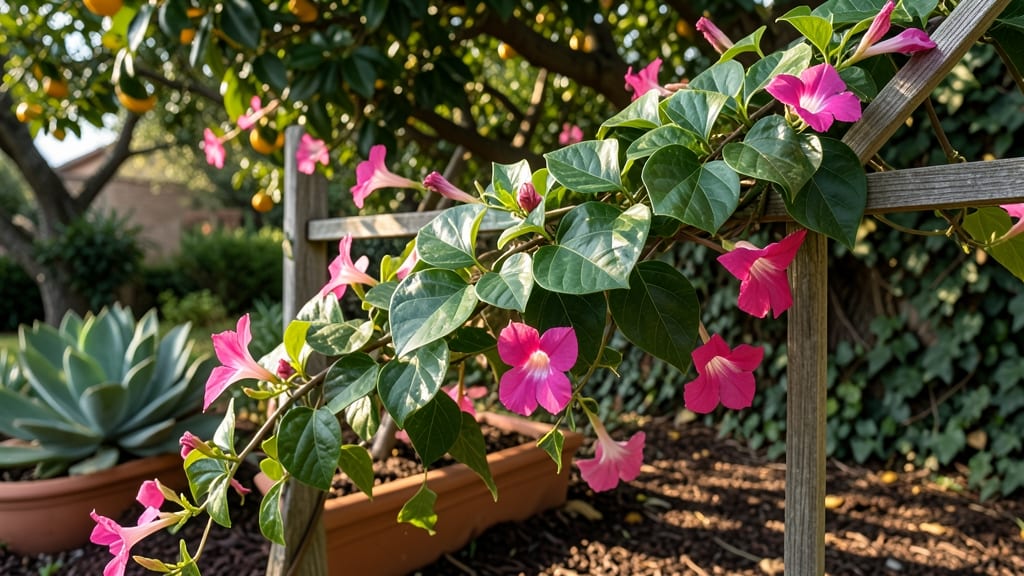
Vining Mandevilla is not a true perennial in cold climates, as it dies back to the ground in frost and must be dug up or protected to survive winter. In USDA zones 9-11, it thrives year-round with minimal care, while colder regions require seasonal adjustments for regrowth each spring.
This tropical beauty behaves like a seasonal plant outside its ideal growing range. 🌱 While it may look lush and permanent in warmer zones, frost triggers a full dormancy cycle, killing the stems and leaves but leaving roots intact in some cases.
The key difference is whether you can relocate or protect the plant—if not, it behaves more like an annual in your area. Many gardeners treat it as a tender perennial, meaning it returns each year with proper winter care, even if it doesn't survive frost on its own.
For those in USDA zones 8 and below, the challenge shifts to strategic overwintering. The plant's ability to regrow depends entirely on whether you can preserve the root system or tubers through winter.
Without intervention, the entire plant will die back completely, only to sprout new growth from the roots when temperatures rise again in spring.
💡 In This Article
- Mandevilla Hardiness Zones Explained
- Winter Care Tips for Vining Mandevilla
Mandevilla hardiness zones explained
Vining Mandevilla thrives naturally in USDA hardiness zones 9-11, where winter temperatures rarely drop below 20°F (-6.7°C). This range aligns with its tropical origins in South America, where it evolves to grow year-round without frost protection.
The plant's tender nature means even light freezes (28-32°F / -2 to 0°C) can cause irreversible damage to stems and leaves, though roots may survive in milder conditions.
In zone 8, where winter lows reach 10-20°F (-12 to -6.7°C), Mandevilla behaves as a tender perennial—it dies back completely but can regrow from roots if protected.
The critical threshold is 25°F (-4°C)
The plant's survival hinges on its root system's resilience. While above-ground growth freezes at 30°F (-1°C), roots can endure brief exposure to 20°F (-6.7°C) if insulated with mulch. However, prolonged cold or wet soil accelerates decay. This biological response mirrors other tropical plants like bougainvillea, which also require protection in cooler climates. What distinguishes Mandevilla from true perennials is its inability to tolerate hard freezes (15°F / -9.4°C or lower). Unlike cold-hardy plants that develop protective sugars in their tissues, Mandevilla lacks these adaptations. Its leaves contain high moisture content (about 75-80% water), which crystallizes and ruptures cell walls during freezing. Gardeners in zone 7 and below face even greater challenges, as winter temperatures often drop below 10°F (-12°C). Here, the plant behaves like an annual unless dug up and overwintered indoors. The root system's survival becomes entirely dependent on human intervention, as natural ground insulation rarely provides sufficient protection against prolonged cold snaps. Consider this comparison: A true perennial like peonies can survive -20°F (-29°C) through winter dormancy, while Mandevilla's roots begin dying at 20°F (-6.7°C). This fundamental difference explains why it's classified as a tender perennial rather than a hardy one.