
Flowers
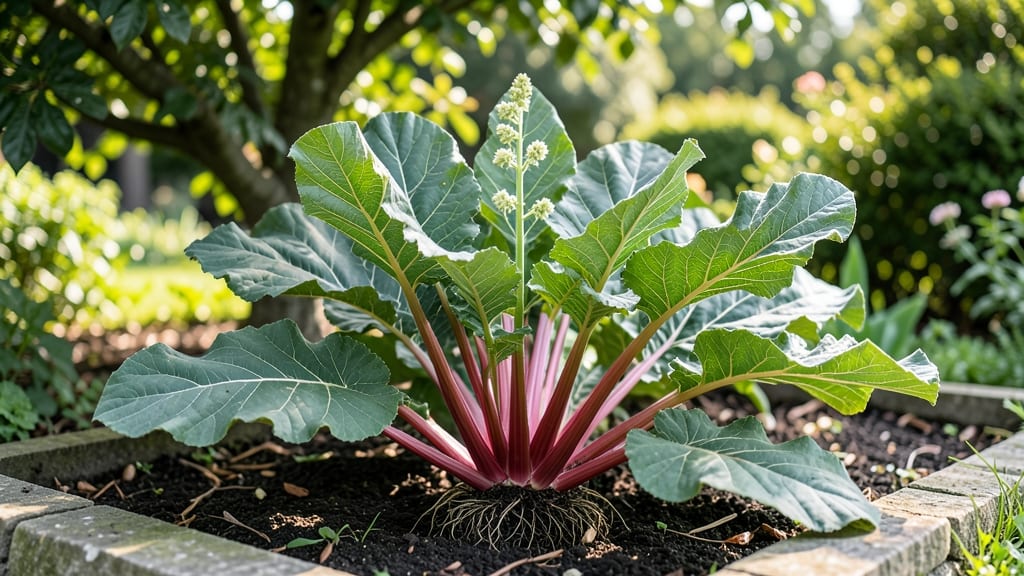
Yes, rhubarb is a perennial plant that lives for many years through its hardy root system, sending up new stalks each spring when cared for properly.
This hardy classification comes from rhubarb's thick, fibrous roots and crown that store energy like a battery, allowing it to regrow annually. 🌱 Unlike annuals that die after one season, rhubarb's root system stays dormant in winter but springs back to life with proper soil drainage and sunlight.
I've seen well-established plants produce for 10+ years with minimal care—just protect them from extreme cold and over-pruning.
What sets rhubarb apart is its ability to thrive in temperate climates where many perennials struggle. The key is maintaining consistent moisture during growing seasons while avoiding soggy soil that can rot those crucial roots.
Many gardeners swear by mulching in fall to insulate the crown through winter, which is exactly how I've kept my plants going strong for over a decade.
💡 In This Article
- How Rhubarb’s Root System Ensures Long-Term Growth
- Caring for Rhubarb as a Perennial Plant
How rhubarb’s root system ensures long-term growth
Rhubarb’s perennial nature stems from its unique thick, fibrous root system and crown, which function like a biological battery. These roots store carbohydrates, nutrients, and water during the growing season, allowing the plant to survive winter dormancy.
Unlike annuals that die after one cycle, rhubarb’s roots remain alive underground, ready to push new shoots when conditions improve. The crown—where the roots meet the stalks—contains meristematic cells that activate in spring, producing fresh growth each year.
The root system extends 12-18 inches deep and spreads 2-3 feet wide, forming a dense network that anchors the plant and absorbs moisture efficiently. This structure is why rhubarb thrives in USDA Hardiness Zones 3-8, enduring temperatures as low as -30°F when properly protected.
The roots’ ability to regenerate makes rhubarb resilient—even if stalks are harvested, the plant can recover as long as at least 50% of the crown remains intact. 🌱
What makes rhubarb truly unique is its secondary growth—unlike many perennials, its roots continue thickening over time, increasing storage capacity. This is why older plants (5+ years) often produce larger, more abundant stalks than younger ones. The trade-off?
Over time, the crown can become crowded, requiring division every 3-4 years to prevent yield decline and disease spread. Without this care, the plant’s energy gets diverted to maintaining old roots instead of producing new growth.
Here’s how the biology translates to garden success: In early spring, the stored energy fuels rapid stalk growth, while summer heat triggers photosynthesis in the leaves, replenishing the root reserves.
This cycle explains why rhubarb’s first harvest in spring is often the most tender—it’s tapping into winter’s stored energy before the plant can fully recharge. 💫
For comparison, think of rhubarb’s roots like a carrot’s storage system, but on steroids. While carrots store energy for a single growing season, rhubarb’s roots are built for decades of regrowth, making it one of the most low-maintenance perennials for patient gardeners.
The key difference lies in the crown’s meristematic activity, which annuals simply lack—this is what classifies rhubarb as a true perennial rather than an annual or biennial.
One common misconception is that rhubarb’s leaves are edible, but they contain oxalic acid—a toxin that can cause kidney damage. The stalks, however, are the plant’s primary edible part, and their growth depends entirely on the root system’s health.
This is why over-harvesting young plants (taking more than one-third of the stalks in a season) can weaken the roots’ ability to regenerate, turning a perennial into a short-lived annual.
To maximize this root system’s potential, focus on well-draining soil (rhubarb hates soggy roots) and consistent moisture—drought stress forces the plant to divert energy from storage to survival.
With the right conditions, a single rhubarb plant can live for 20+ years, proving that its perennial classification isn’t just a label—it’s a biological superpower. ✨