
Tools
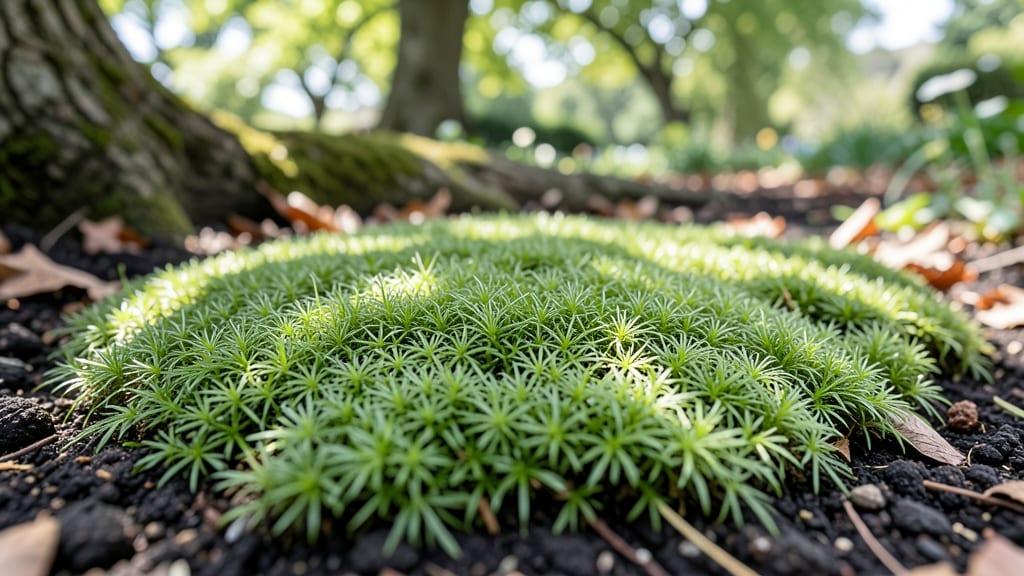
Irish moss behaves like a perennial in coastal marine gardens, but it's not a true perennial in traditional gardening terms. This algae dies back each winter but regenerates from spores annually, lacking woody stems or underground storage structures.
This behavior might confuse gardeners because Irish moss thrives in the same spots year after year, just like perennials. 🌊 The key difference lies in its biology: instead of relying on roots or rhizomes, it survives harsh winters as dormant spores buried in the substrate.
Once temperatures rise, these spores germinate and form new fronds, creating the illusion of perennial growth without the structural adaptations.
For those cultivating Irish moss long-term, understanding this cycle is crucial. Unlike true perennials, it doesn't develop persistent underground structures, making it more vulnerable to environmental changes. Proper substrate preparation—like using a mix of sand and peat—helps maintain its growth pattern year-round in controlled settings.
💡 In This Article
- Why Irish Moss Appears Perennial Despite Annual Dieback
- Growing Irish Moss Like a Perennial: Best Practices for Long-Term Cultivation
Why Irish moss appears perennial despite annual dieback
Irish moss (Chondrus crispus) survives winter through a clever biological adaptation: its thallus (the leafy, branching structure) breaks down, but the organism persists as microscopic spores embedded in the substrate.
Unlike true perennials that store energy in roots or rhizomes, Irish moss relies on these spores—each measuring just 0.05-0.1 millimeters—to restart growth when conditions improve. This process is called haploid sporulation, where the algae releases spores that germinate into new fronds without needing a dormant root system.
The confusion arises because Irish moss thrives in the same coastal zones year after year, much like perennials. However, its survival mechanism is fundamentally different: true perennials use underground structures to regrow, while Irish moss regenerates from spores dispersed in the substrate.
In colder months, the thallus decomposes, but the spores remain viable in moist, sheltered environments, ready to germinate as temperatures rise above 50°F. This cycle explains why gardeners often assume it’s a perennial—it appears to return annually without replanting.
Another key difference is its lack of woody stems or lignified tissues. Most terrestrial perennials develop rigid structures to support growth, but Irish moss’s thallus is soft and flexible, composed of 80% polysaccharides like carrageenan, which makes it more vulnerable to freezing.
When temperatures drop below 32°F, the thallus dies back, but the spores buried in the substrate remain protected by the surrounding sand or peat. This is why proper substrate preparation—like using a mix of 70% sand and 30% peat moss—is critical for long-term cultivation.
What makes this adaptation fascinating is how it mirrors the life cycle of some seaweeds and lichens. Irish moss doesn’t just survive winter—it reprograms its growth cycle entirely. The spores can remain dormant for months, waiting for ideal conditions (warmth, moisture, and sunlight) before germinating.
This strategy allows it to dominate intertidal zones where true perennials would struggle, as it doesn’t rely on persistent structures but instead leverages rapid, spore-driven regeneration.
For gardeners, this means Irish moss behaves like a perennial in practice but lacks the structural resilience of one. Its growth is tied to environmental cues rather than internal storage systems.
For example, in controlled aquariums or marine gardens, maintaining a stable pH of 7.5-8.5 and consistent water flow helps mimic its natural coastal habitat, reducing dieback and encouraging spore germination. Without these conditions, the spores may fail to activate, leading to apparent "failure" in perennial-like behavior.
Understanding this cycle is key to cultivating Irish moss successfully. Unlike true perennials, it doesn’t reward neglect—it demands precise environmental control to thrive. Yet, once those conditions are met, it can regenerate with astonishing speed, often forming dense mats within 4-6 weeks of spore germination.
This duality—appearing perennial but functioning as an annual spore-dependent organism—is what makes Irish moss so unique in coastal ecosystems.