
Flowers
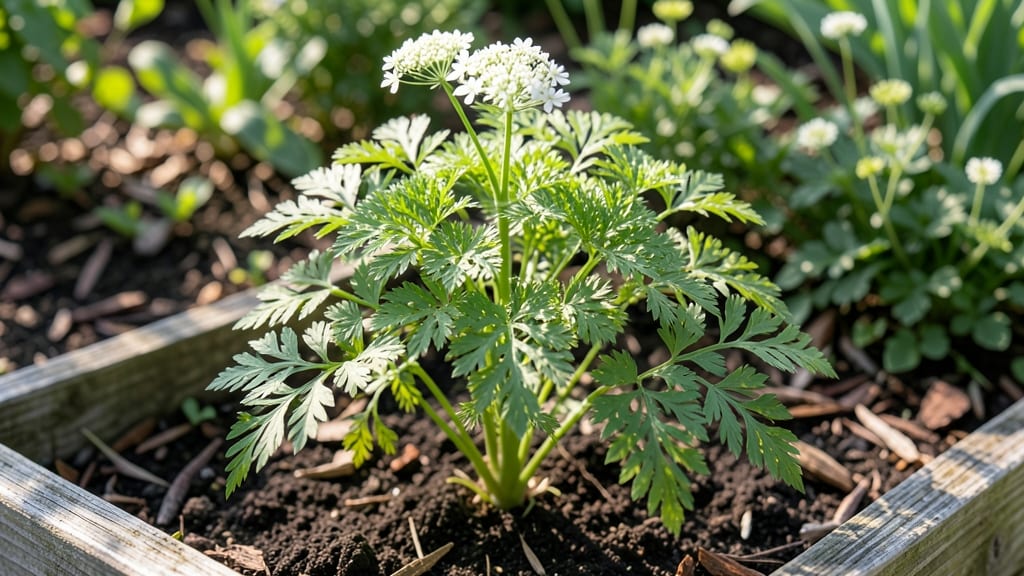
Chervil is not a true perennial but behaves as a biennial or short-lived perennial, dying back in winter only to regrow from its root crown in milder climates before eventually declining after 1-2 years.
Chervil's lifespan is a fascinating mix of annual and perennial traits.
Unlike true perennials that return reliably year after year, chervil's delicate taproot system makes it highly sensitive to cold, causing it to go dormant in winter. 🌱 In regions with mild winters, it often surprises gardeners by resprouting from its root crown, but this doesn't guarantee long-term survival—most plants fade after just one or two growing seasons.
This behavior explains why chervil is often treated as an annual in colder climates, despite its occasional perennial tendencies.
What sets chervil apart is its ability to self-seed under ideal conditions, creating a natural succession of plants. This makes it particularly useful for gardeners who want fresh leaves throughout the growing season without replanting.
The key to maximizing its lifespan lies in understanding its environmental needs—well-draining soil, consistent moisture, and protection from harsh winter winds can significantly extend its productive years.
For those wondering how to classify chervil in their garden planning, think of it as a "short-term perennial" or "biennial with potential."
While it won't provide the decades-long reliability of plants like asparagus, its quick regrowth and flavor make it a valuable addition to any herb garden when treated with care.
💡 In This Article
- Why Chervil’s Lifespan Falls Between Annuals and Perennials
- How to Extend Chervil’s Harvest Life in Your Garden
Why chervil’s lifespan falls between annuals and perennials
Chervil's botanical classification as a "short-lived perennial" stems from its unique root system—a delicate taproot that stores minimal energy reserves compared to true perennials like rosemary or thyme. This taproot typically measures only 4-6 inches deep, making it highly vulnerable to frost penetration (28°F or lower), which triggers dormancy.
Unlike fibrous-rooted perennials that spread horizontally, chervil's vertical root structure lacks the sturdiness to survive harsh winters, explaining why it often dies back completely in colder zones 🌱
The key difference lies in chervil's growth cycle: it produces flowers and seeds in its first year (annual behavior) but may regrow from its root crown in spring if conditions are mild (perennial behavior).
True perennials like parsley or cilantro develop more robust crowns that regenerate reliably, while chervil's crown is more fragile—often requiring 50-60°F soil temperatures to break dormancy. This explains why chervil thrives in USDA zones 5-9 but struggles in colder regions.
What makes chervil's behavior particularly interesting is its cold sensitivity during different growth stages. Young plants (3-4 weeks old) can survive light frosts (30°F), but mature plants with established roots may still die back if exposed to prolonged cold (14 days below 32°F).
This sensitivity contrasts sharply with hardy perennials like oregano, which can withstand -10°F temperatures without issue.
Chervil's biennial tendencies become apparent in its second year when it focuses energy on flowering rather than leaf production. The plant's 18-24 inch height at maturity is partly due to this reproductive shift, which weakens its structural integrity.
Unlike true perennials that maintain vigorous growth, chervil's energy allocation makes it more susceptible to environmental stressors, accelerating its decline after 1-2 years.
The science behind chervil's lifespan involves its Caucasian origin—a region with mild winters that shaped its delicate constitution. This adaptation explains why chervil performs best in Mediterranean climates where winters rarely drop below 35°F.
In colder regions, gardeners must treat it as an annual or use protective measures to mimic its native conditions.
What most gardeners don't realize is that chervil's short lifespan isn't just about cold tolerance—it's also about its self-seeding capability. When allowed to go to seed, chervil naturally propagates, creating a continuous supply of new plants.
This self-sustaining cycle explains why chervil often appears perennial in gardens where it's not actively managed—it's not the same plants returning, but rather a succession of new growth from seeds 💫
To truly understand chervil's classification, consider this comparison: while parsley (a true perennial) might live 5+ years with proper care, chervil's maximum potential is 2-3 years in ideal conditions. This fundamental difference in longevity explains why chervil is often grouped with biennials in botanical classifications, despite its occasional perennial behavior.