
Plants
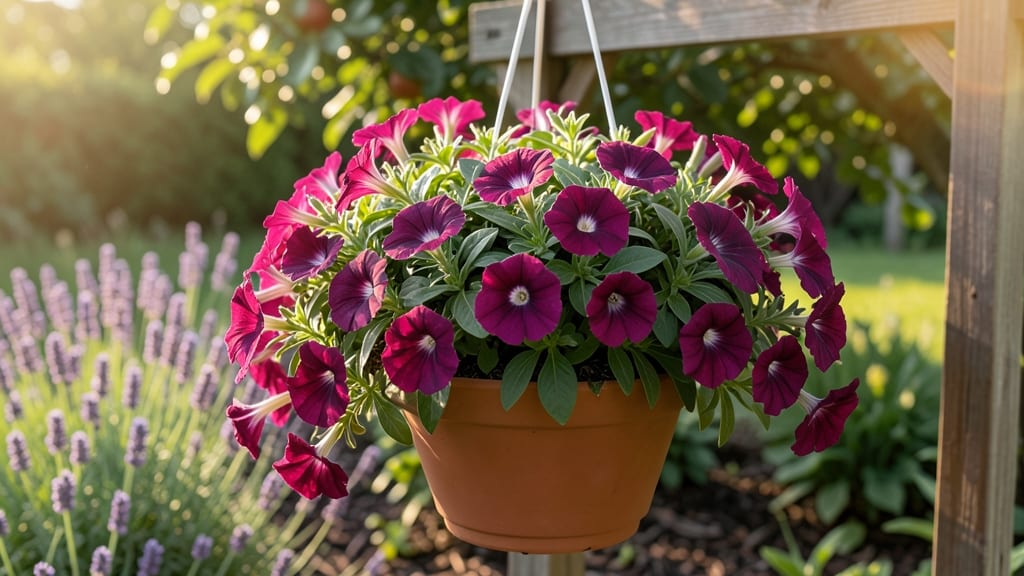
Wave petunias are not perennials in most climates, dying back to the ground in cold zones and requiring replanting each spring. Their tender nature makes them annuals in USDA zones below 10, though they self-seed prolifically in mild winters.
Wave petunias act like annuals because their delicate stems and tropical origins can't withstand freezing temperatures. 🌱 Even a light frost will kill their foliage, though the roots may survive in milder zones. This explains why gardeners in chilly regions treat them as yearly plants—replanting each spring is standard practice.
What's interesting is how they adapt: in zones 9-10, they often return naturally through self-seeding, creating fresh blooms without human intervention.
Their lack of cold hardiness stems from their breeding—wave petunias were developed for vibrant, cascading flowers rather than winter survival. Unlike hardy perennials that develop protective layers during dormancy, these plants prioritize lush growth over frost resistance.
This trade-off makes them perfect for summer containers but requires careful planning if you want to keep them year-round.
💡 In This Article
- Why Wave Petunias Freeze in Cold Weather
- Extending Wave Petunia Growth in Cooler Climates
Why wave petunias freeze in cold weather
Wave petunias originate from tropical regions of South America, where temperatures rarely drop below 50°F—their ideal growing range. This tropical heritage explains their sensitivity to frost.
Unlike hardy perennials like coneflowers or lavender, which develop protective woody stems or deep root systems, wave petunias have soft, herbaceous stems that lack the structural resilience to survive freezing. When temperatures hit 32°F or lower, their cell walls rupture from ice crystal formation, causing irreversible damage within hours.
Their shallow root systems—typically only 6-12 inches deep—provide minimal insulation against cold ground temperatures. In contrast, established perennials like hostas develop extensive root networks that store energy and protect against winter chill.
Wave petunias also lack the dormancy mechanisms of true perennials, such as reduced metabolic activity or protective leaf coatings. Instead, they continue active growth until frost hits, making them particularly vulnerable to sudden temperature drops.
Even in USDA Zone 8 (where winters rarely drop below 10°F), wave petunias often die back completely. What survives are the roots in mild winters, which may resprout if protected by 3-4 inches of mulch. However, without this insulation, the roots also succumb to freezing.
The key difference from perennials is that wave petunias don't regenerate from a protected underground structure—they rely entirely on new growth each season, which is why replanting becomes necessary in colder zones.
Botanically, their classification as Petunia × hybrida 'Wave' hybrids emphasizes ornamental traits over survival. Breeders prioritized compact growth habits, prolonged blooming, and trailing forms over cold tolerance.
This explains why even "cold-hardy" petunia varieties (like Petunia × atkinsiana) only survive to Zone 7—wave petunias push these limits even further by being 2-3 zones more tender.
What makes this particularly frustrating for gardeners is how quickly frost damage occurs. A single night below 30°F can blacken foliage within 12-24 hours, while roots may take 3-5 days to show signs of failure.
This rapid decline contrasts sharply with perennials like peonies, which may show frost damage only after prolonged exposure to 20°F. The lack of warning time forces gardeners to act proactively—either by bringing plants indoors or accepting their annual nature.
Interestingly, wave petunias exhibit a survival strategy in milder climates: self-seeding. When temperatures stay above 40°F through winter, their seeds germinate naturally in spring. This isn't true perennation but rather a reproductive adaptation.
True perennials like black-eyed Susans regrow from established root crowns, while wave petunias rely on this seed-based renewal, which is why gardeners often find unexpected seedlings popping up year after year in Zones 9-10.