
Orchid Care
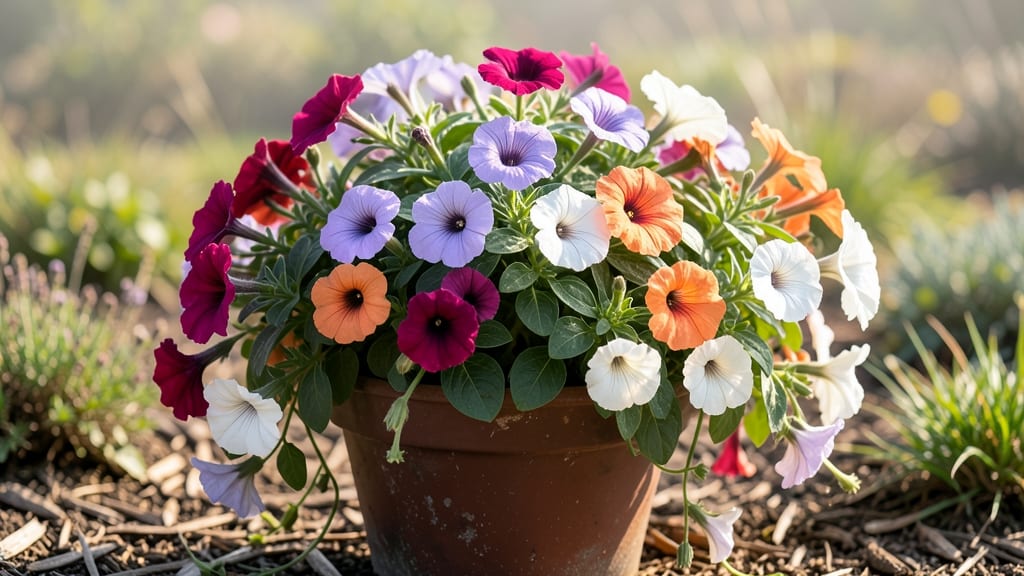
Petunias act as annuals in most climates but can be perennials in USDA Zones 10-12, where their roots survive winter underground and regrow from stored energy. In colder zones, frost kills their foliage, requiring spring replanting.
Whether petunias thrive as annuals or perennials depends entirely on your climate zone. 🌱 In warmer regions like Florida or Southern California, these vibrant flowers naturally overwinter in the soil, emerging fresh each spring from their tuberous roots.
The key difference lies in their root systems—petunias store energy underground, allowing them to rebound when conditions improve. However, in frost-prone areas, gardeners must treat them as annuals since the cold snaps destroy their above-ground growth, leaving only dormant roots to replant from next season.
This dual nature makes petunias incredibly adaptable. While they won't survive harsh winters in their native form, gardeners in cooler climates can still extend their growing season through careful overwintering techniques.
The secret lies in protecting those vital roots—whether by digging and storing tubers or using frost blankets—so you can enjoy their cheerful blooms year after year with minimal effort.
💡 In This Article
- Why Petunias Die Back in Cold Climates
- How to Overwinter Petunias in Cold Zones
Why petunias die back in cold climates
Petunias behave as annuals in cold climates because their above-ground growth is frost-sensitive, while their tuberous roots remain dormant underground. When temperatures drop below 28°F, the cell membranes in petunia leaves rupture from ice crystal formation, causing irreversible damage.
This process, called freeze-thaw injury, kills the foliage but leaves the roots intact—like a hibernating bear that loses its fur but keeps its core warm. 🌡️
The roots store starch and sugars during the growing season, converting sunlight into energy reserves that can sustain regrowth when temperatures rise. In USDA Zones 10-12, where winters rarely drop below 30°F, these roots remain viable year-round, allowing petunias to rebound naturally.
However, in colder zones (like Zone 5), even a single hard freeze can destroy the plant's ability to photosynthesize, forcing gardeners to replant from cuttings or seeds each spring.
This survival mechanism is similar to other tuberous plants like dahlias or potatoes, which also rely on underground storage organs. The difference? Petunias have shallower roots (typically 6-12 inches deep), making them more vulnerable to temperature fluctuations near the soil surface.
In frost-prone areas, the ground itself may freeze solid, cutting off oxygen to the roots—a secondary stressor that accelerates decline. 🥶
What most gardeners overlook is the timing of dormancy. Petunias enter a semi-dormant state when day lengths shorten (below 12 hours of sunlight), triggering a hormonal shift that prioritizes root storage over flower production.
This adaptation explains why they bloom so vigorously in summer but shut down abruptly in fall—it’s not just cold, but the photoperiod that signals their annual cycle in colder climates.
To visualize this, imagine a petunia as a two-part system: the top (leaves/stems) is the "disposable" part that dies back, while the roots act as a biological battery.
In warm zones, this battery recharges annually; in cold zones, it’s like a phone left plugged in but never used—still functional, but requiring manual intervention to revive. 🔋
Here’s the botanical kicker: even in perennially warm zones, petunias won’t survive indefinitely without human care. Their tuberous roots eventually exhaust their energy reserves after 3-5 years, requiring division or replanting.
This is why gardeners in Zones 10-12 still need to rotate planting locations—even "perennial" petunias have a finite lifespan. 🌱