
Plants
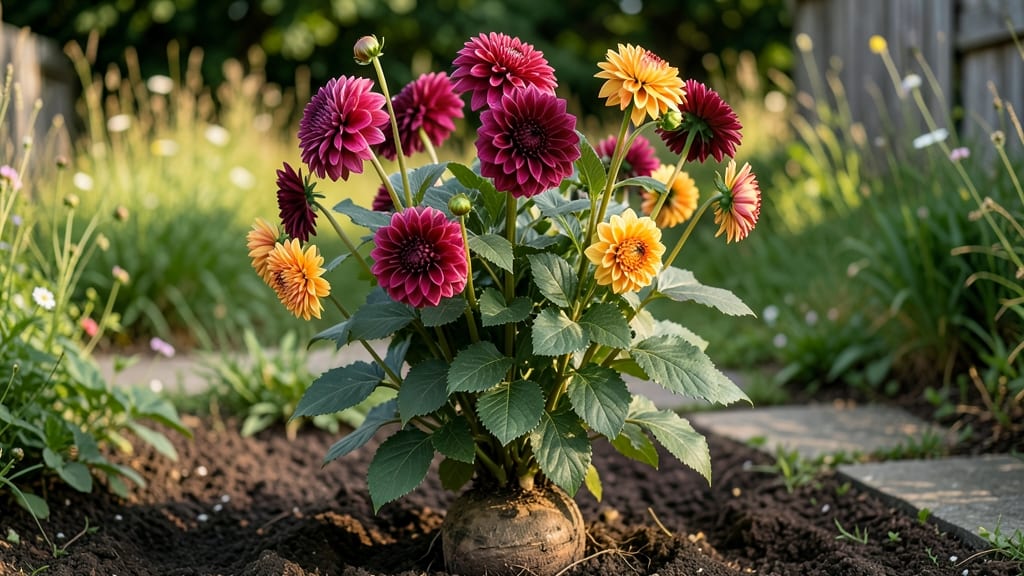
Dahlias in Zone 8 aren't true perennials—they go dormant each winter but can live multiple years with proper care. Most varieties need winter protection like mulch or storage, though cold-resistant types like 'Café au Lait' may survive mild winters naturally.
In Zone 8, dahlias behave like seasonal perennials—they shut down above ground but rely on their underground tubers to regenerate.
The challenge is that most tubers can't handle prolonged temperatures below 20°F, which is common in Zone 8 winters. 🌱 Without protection, the tubers freeze and die, forcing gardeners to replant annually.
The few exceptions, like 'Café au Lait,' have naturally thicker tubers that tolerate brief cold snaps better, but even these benefit from extra mulch during harsh freezes.
This dieback cycle happens because dahlias originate from Mexico's high-altitude regions where they evolved to handle dry seasons, not freezing winters. True perennials like peonies or hostas have deep root systems that survive winter dormancy, while dahlias depend entirely on their tubers—which are more like bulbs than true perennial roots.
💡 In This Article
- Why Dahlias Die Back in Zone 8 Winters
- Zone 8 Dahlia Winter Survival Strategies
Why dahlias die back in Zone 8 winters
Dahlias enter dormancy in Zone 8 because their tubers are highly sensitive to cold—most varieties cannot survive prolonged exposure to temperatures below 20°F. Unlike true perennials like peonies, which have deep, woody root systems, dahlias rely on fleshy tubers that store nutrients.
These tubers begin to freeze at around 15°F, causing cellular damage that halts regrowth. 🌱 The plant's natural response is to shut down above ground, conserving energy in the tubers until spring warmth triggers regrowth.
The key difference lies in their evolutionary origins: dahlias hail from Mexico's high-altitude regions where they adapted to dry seasons, not freezing winters. True perennials like hostas evolved in colder climates with hardy root structures that can withstand frost.
In contrast, dahlia tubers contain high moisture content (about 75-85% water), making them vulnerable to ice crystal formation during freezes. Even a single night below 20°F can kill unprotected tubers in the ground.
Soil temperature plays a critical role in this process. Dahlias begin their dormancy cycle when nighttime temperatures consistently drop below 50°F for several weeks. At this point, the plant stops producing foliage and redirects energy to the tubers.
The tubers themselves enter a state of metabolic slowdown, similar to how a bear hibernates—just without the protective fur. This biological shutdown explains why dahlias look dead in winter but can regrow from tubers if protected from extreme cold.
Zone 8's winter conditions create a perfect storm for tuber damage. While the zone's mild winters (average lows of 20-30°F) are survivable for some plants, dahlia tubers lack natural insulation. A hard freeze—even a rare one—can push temperatures below 15°F for days, causing irreversible damage.
This is why gardeners in Zone 8 must treat dahlias as seasonal perennials rather than true perennials like lavender or coneflowers, which handle the same conditions without intervention.
What most gardeners don't realize is that even the hardiest dahlia varieties have a 3-5°F tolerance buffer. For example, 'Café au Lait' may survive a 20°F night, but prolonged exposure or additional stress (like wet soil) can push it beyond its limits.
The tuber's outer skin also plays a role—thicker-skinned varieties like dinnerplate dahlias have slightly better cold resistance than delicate pompon types, but the difference is marginal without protection.
To visualize this, imagine a dahlia tuber as a water balloon: when frozen, the ice crystals expand and rupture the cells. In true perennials, the root structure is more like a reinforced concrete foundation—it can flex and endure cold.
Dahlias, however, are more like a delicate glass vase: beautiful but easily shattered without proper care. This fragility is why they require seasonal intervention in Zone 8's borderline climate. 🌡️