
Plants
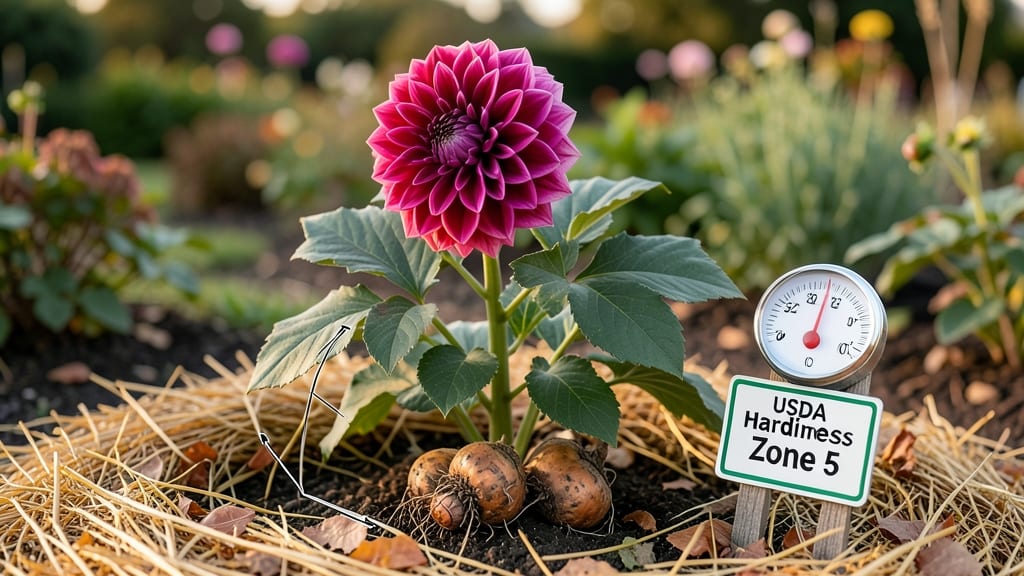
Dahlias are NOT true perennials in Zone 5—they die back to the ground each winter and must be dug up and stored indoors to survive. Their tuberous roots can be overwintered properly to regrow the following season, but they require careful protection from freezing temperatures below 20°F.
Dahlias might look like perennials with their long-lived roots, but in Zone 5's harsh winters, they behave more like hardy annuals. 🌱 The confusion comes from their tuberous nature—they store energy underground, allowing them to regrow if properly protected.
Unlike true perennials that survive winter in the soil, dahlias need human intervention to make it through freezing temperatures. Even cold-hardy varieties like 'Café au Lait' can't withstand Zone 5 winters without being dug up and stored in a cool, dry place.
This overwintering process is what keeps your dahlias coming back year after year. The key is timing—wait until after the first frost when the foliage has died back completely.
Then carefully dig up the tubers, cure them for a few days, and store them in a container with dry peat moss or sawdust. With this extra care, you'll get stunning blooms again next summer!
💡 In This Article
- Why Dahlias Act Like Perennials Despite Zone 5 Freezes
- Step-by-Step Guide to Overwintering Dahlias in Zone 5
Why dahlias act like perennials despite Zone 5 freezes
Dahlias are technically tuberous perennials in their native warm climates, but their survival in Zone 5 hinges on a critical biological adaptation: tuber dormancy. Unlike true perennials that develop woody stems or rhizomes to survive winter, dahlias store all their energy in thickened underground tubers.
These tubers contain specialized cells that can enter a deep dormancy state when temperatures drop below 50°F, halting growth until spring. However, Zone 5's extended freezing periods (often below 20°F for weeks) push these tubers beyond their natural cold tolerance.
The cold hardiness of dahlias varies dramatically between cultivars. For example, heirloom varieties like 'Café au Lait' can tolerate brief dips to 25°F when fully dormant, while modern hybrids like 'Galaxy' typically struggle below 30°F. This difference occurs because newer cultivars prioritize flower production over hardiness.
What's fascinating is how the tuber's outer skin thickens during dormancy—like a natural insulation layer—but even this protection fails when exposed to prolonged sub-zero temperatures. 🌡️ The tuber's internal chemistry also shifts, converting stored starches into sugars that act as antifreeze, but this only works within narrow temperature limits.
Here's where the botanical paradox comes in: while dahlias aren't true perennials in Zone 5, their tuberous nature gives them perennial-like potential when properly managed.
This is why gardeners often refer to them as "tender perennials"—they have the genetic potential to regrow annually, but require human intervention to survive our climate. The tuber's ability to regenerate from just a small piece (even a single "eye") demonstrates this remarkable resilience when protected from freezing.
What most gardeners don't realize is how quickly tuber damage occurs. Studies show that tubers lose 50% of their viability after just 24 hours at 15°F, with complete cell death occurring at -5°F. This rapid deterioration explains why even cold-hardy varieties fail if left in the ground.
The tuber's vascular system freezes and ruptures, preventing water uptake even if temperatures later rise. This physiological response is what forces Zone 5 gardeners into the overwintering process entirely.
Consider this comparison: a true perennial like peonies can survive Zone 5 winters because their woody stems contain antifreeze proteins that prevent ice crystal formation. Dahlias lack these proteins—their survival depends entirely on their ability to enter dormancy before ground freeze.
The timing of this dormancy is crucial: tubers must reach their maximum dry weight (typically after 60-90 days of growth) before winter sets in, otherwise they'll be too immature to survive storage.
The science behind tuber dormancy involves complex hormonal changes. As daylight shortens in fall, dahlias produce higher levels of abscisic acid—a plant hormone that triggers dormancy. This hormone causes the tuber's outer cells to thicken and form a protective layer called the "periderm."
Meanwhile, growth hormones like gibberellins drop dramatically, halting all above-ground growth. However, this natural process only works if temperatures stay above 40°F—once frost hits, the tuber's metabolic processes shut down abruptly, leaving it vulnerable.