
Pests and Diseases
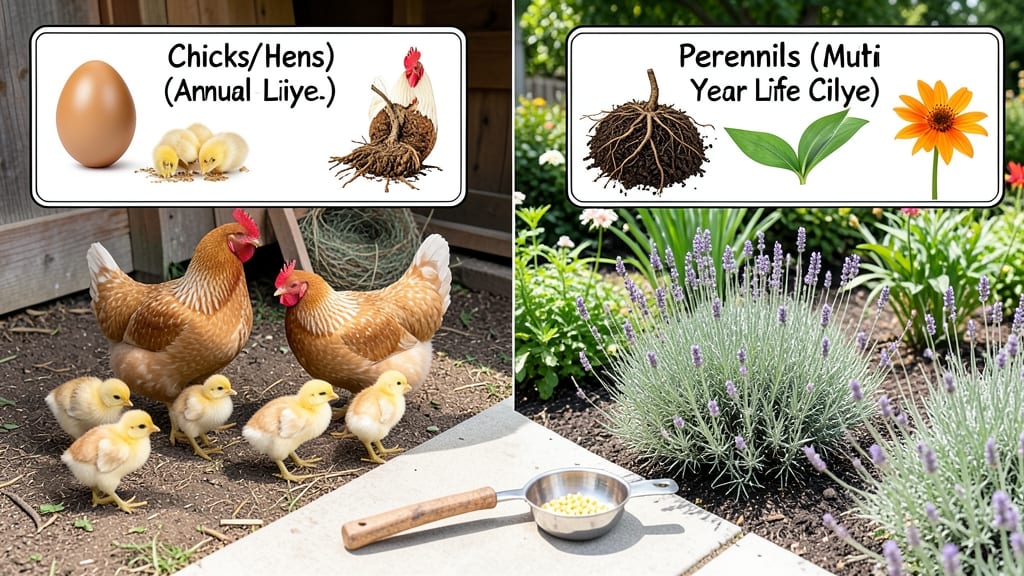
Chicks and hens are not perennials—they are annuals in the poultry world, meaning each generation must be replaced as they age or die, rather than regrowing like perennial plants. Their lifespan averages 5-10 years, depending on breed and care, but they do not naturally reproduce or persist indefinitely like true perennials do in gardening.
Chickens are classified as annuals because their lifespan is finite and tied to their biological purpose—egg production and meat quality.
Unlike perennial plants that regenerate year after year, hens eventually decline in productivity, requiring new stock to maintain a sustainable flock. 🌱 This distinction matters for backyard farmers who need to plan for replacements every few years, just as gardeners would replant annuals like tomatoes rather than expecting them to return indefinitely.
What makes this different from gardening is that chickens don't "reproduce indefinitely" like perennial herbs or fruit trees. Even with proper care, their egg output drops after 2-3 years, and their health declines—making them more like seasonal crops than self-sustaining perennials.
This is why serious poultry keepers rotate breeds or cull older hens to maintain efficiency.
💡 In This Article
- Why Chickens Are Classified as Annuals in Poultry Science
- How to Extend a Chicken Flock’s Productive Lifespan Like a Perennial Plant
Why chickens are classified as annuals in poultry science
Chickens are classified as annuals because their biological lifecycle mirrors that of agricultural annuals like corn or wheat—finite and tied to a single reproductive cycle.
Unlike perennial plants such as lavender or apple trees, which regenerate from the same root system year after year, hens have a predictable decline in productivity after 2-3 years of egg-laying.
This is due to their reproductive biology: hens experience a natural decline in ovarian function, similar to how annual plants exhaust their energy reserves after flowering.
The key difference lies in their domestication and selective breeding. Wild ancestors like red junglefowl had shorter lifespans (2-3 years) due to predation and food scarcity.
Modern breeds, however, have been selectively bred for traits like high egg production (e.g., Leghorns lay 280-320 eggs/year) or meat quality, but this comes at the cost of accelerated aging.
Their metabolic rate—especially in high-production hens—accelerates wear on organs like the heart and kidneys, making them more like high-yield crops than self-sustaining perennials. 🌱
Another critical factor is their reproductive strategy. Perennial plants invest in root systems or woody growth to survive harsh seasons, while chickens rely on rapid reproduction (chicks fledge in 6-8 weeks) to ensure genetic continuity.
Unlike perennial herbs that spread via rhizomes, hens don’t "regrow" from the same stock—they must be replaced when their egg output drops below 50% of peak production (typically after 2-3 years).
This is why backyard flocks often see a generational turnover every 3-5 years, mirroring how gardeners replant annual vegetables.
Poultry scientists further classify chickens as annuals because their economic lifespan aligns with agricultural cycles. A hen’s peak egg production occurs at 1 year old, but by 5 years, most breeds lay fewer than 50 eggs/year.
This decline is irreversible, unlike perennial plants that can rebound with proper care. Even with optimal nutrition (e.g., 16-18% protein feed), hens can’t "reset" their reproductive systems like a gardenia bush regrows after pruning. 🌿
Consider this comparison: A strawberry plant (perennial) produces fruit for decades, while a chicken’s egg-laying window is compressed into a 2-3 year peak.
The analogy breaks down further when you factor in predation, disease, or environmental stress—chickens lack the resilience of perennial plants, which can lie dormant or regrow from roots. Even free-range hens, with their natural behaviors, can’t escape this biological limit without human intervention (e.g., artificial insemination or selective breeding).
For those new to poultry keeping, this classification explains why flock management feels more like crop rotation than gardening.
Just as a farmer wouldn’t expect a wheat field to yield the same harvest indefinitely, chicken keepers must plan for replacements every 3-5 years—a reality that sets them apart from perennial plant enthusiasts who enjoy long-term harvests from the same stock. 🐔