
Vegetables
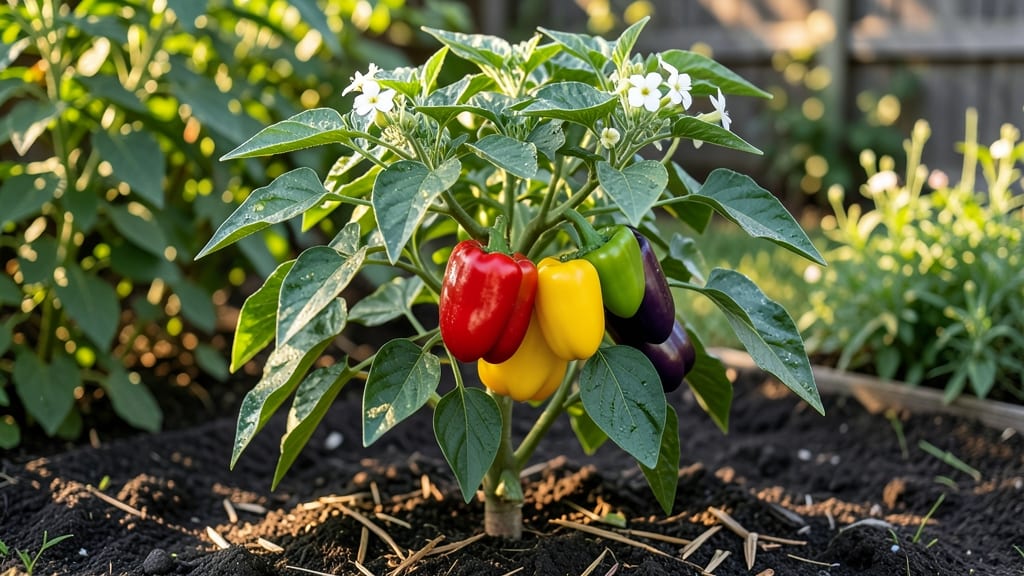
Bell peppers aren't perennial in most climates, though they can survive mild winters in frost-free zones (10-11) by going dormant until spring. Any frost or temperatures below 50°F will kill them, forcing gardeners to replant each year.
This behavior often confuses gardeners because bell peppers look like they're coming back from the roots, but they're actually tender annuals that die back to the ground. 🌱 In warmer zones, they may regrow from the base in spring, creating the illusion of perennial growth.
The key difference is that true perennials regenerate from hardened roots or crowns, while bell peppers rely on new seedlings each season.
What's interesting is how this affects growing strategies. In colder regions, gardeners often extend the season by starting seeds indoors or using black plastic mulch to protect the soil. I've seen some creative solutions like overwintering plants in containers that can be moved indoors or into greenhouses when temperatures drop.
💡 In This Article
- Why Bell Peppers Die Back in Winter (And How It Differs From True Perennials)
- Extending Bell Pepper Lifespan: Overwintering and Year-Round Growing Hacks
Why bell peppers die back in winter (and how it differs from true perennials)
Bell peppers belong to the Capsicum annuum species, which are classified as tender annuals rather than true perennials. Their growth habit is triggered by warm temperatures—ideal growth occurs between 70-85°F, with anything below 55°F slowing photosynthesis dramatically.
When nighttime temperatures dip near 50°F, cellular damage begins, causing leaves to yellow and wilt as chlorophyll breaks down. This is fundamentally different from perennials like asparagus or rhubarb, which store energy in hardened roots or crowns to regenerate each spring.
The confusion arises because bell peppers can survive mild winters in frost-free zones (USDA zones 10-11) by going dormant at the base.
However, this isn't true perennialism—it's a survival mechanism where the plant conserves energy until warm weather returns. 🌱 In these zones, you might see regrowth from the same base in spring, but this is essentially a new plant emerging from residual roots, not a true perennial cycle.
True perennials like artichokes or horseradish have specialized underground structures that regenerate year after year without replanting.
What makes this distinction critical is the plant's response to cold stress. Bell peppers lack the cold-hardy adaptations of true perennials, such as antifreeze proteins or deep root systems that insulate against temperature swings.
Their thin stems and broad leaves make them particularly vulnerable to 32°F frost, which causes ice crystals to form in plant cells—a process called freeze-thaw injury. This cellular damage is irreversible, which is why even partial winter survival in warm zones still requires replanting the following season.
Another key difference lies in their reproductive strategy. Annuals like bell peppers focus all their energy on flowering and fruiting within a single growing season, while perennials allocate resources to both reproduction and root/crown maintenance.
This is why you'll never see bell peppers producing fruit in their second year—they've already expended all their energy on the current season's harvest. 💫 In contrast, a true perennial like a tomato (in its native tropical climate) would continue growing indefinitely if protected from frost.
Gardeners often mistake bell peppers for perennials because they sometimes regrow from the base in spring, especially in warm microclimates. This regrowth occurs because the plant's root system may survive if protected by mulch or soil insulation, but it's not a reliable strategy.
The new growth is essentially a sucker from the original plant's base, not a true perennial regrowth. For comparison, consider how strawberries produce runners—similar but fundamentally different from true perennial regeneration.
The temperature threshold where this becomes problematic is 45°F for extended periods. Below this, even the most cold-tolerant bell pepper varieties will suffer irreversible damage. This is why gardeners in zones 8-9 often treat them as annuals, even if they occasionally survive winters.
The plant's inability to harden off (develop cold resistance) is what truly defines it as an annual, not just its single-season harvest cycle.