
Plants
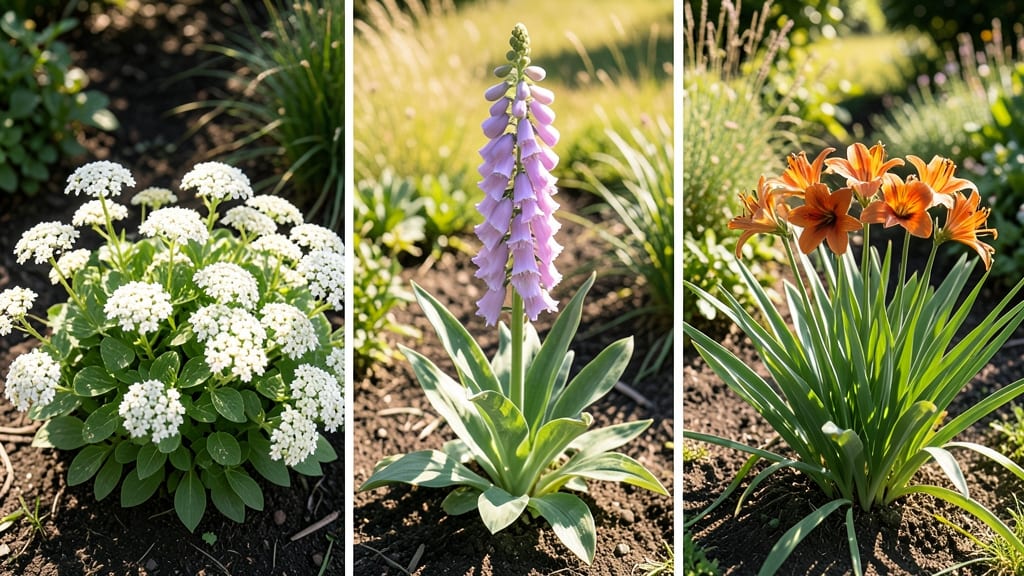
To distinguish annuals, biennials, and perennials, focus on their growth cycles: annuals bloom and die in one season, biennials grow leaves the first year and flowers the second, while perennials return yearly from their roots. Observe their flowering patterns and stem structure for clear identification.
Understanding these differences helps you plan your garden more effectively. Annuals like marigolds or petunias deliver quick color but require replanting each year, while biennials such as foxglove or hollyhock store energy underground during their first season to burst into dramatic blooms the next.
Perennials like black-eyed Susans or coneflowers offer long-term beauty with minimal replanting—just divide their clumps every few years to keep them thriving. 🌱 The key is watching how they grow and flower over time, as these patterns reveal their true nature.
For example, if you spot a plant with woody stems that persist through winter, it’s likely a perennial. If it flowers abundantly in its first year, it’s probably an annual. Biennials often look like leafy green bushes their first year before sending up flower stalks the following spring.
These visual cues make identification straightforward once you know what to look for.
💡 In This Article
- Life Cycle Science: How Plant Growth Patterns Define Annuals, Biennials, and Perennials
- Field Guide: Quick Visual Cues for Identifying Plant Types in Your Garden
Life cycle science: how plant growth patterns define annuals, biennials, and perennials
The fundamental difference between annuals, biennials, and perennials lies in their seed-to-seed life cycle timing and how they allocate energy. Annuals like marigolds or zinnia complete their entire lifecycle—germination, growth, flowering, seed production—in just one growing season (typically 6-12 months).
Their seeds contain all the genetic instructions to trigger rapid growth when conditions are right, often requiring specific temperature thresholds (like 50-60°F for many warm-season annuals) to break dormancy. This "live fast, die young" strategy maximizes reproduction before resources are exhausted.
Biennials like carrots or foxglove follow a two-phase strategy: they focus on vegetative growth (leaf production) during their first year, storing energy in taproots or underground stems. This stored energy fuels their second-year flowering and seed production.
The transition is triggered by day length changes (photoperiodism) and cold exposure—many biennials need a period of 4-6 weeks below 50°F to "know" winter has passed and it's time to flower. Without this cold treatment, biennials may revert to annual behavior, blooming in their first year.
Perennials like lavender or hostas take a completely different approach by developing persistent root systems (rhizomes, tubers, or crowns) that survive winter dormancy. Their aboveground growth dies back each year, but the meristematic tissues (growth centers) remain alive underground.
This allows perennials to allocate resources to both reproduction and vegetative growth annually. The trade-off? Their first year often focuses on establishing strong roots before producing flowers, which is why many perennials bloom most vigorously in their second or third year after planting.
Environmental factors play a crucial role in these patterns. Annuals thrive in unstable climates where quick reproduction is essential for survival, while perennials dominate stable ecosystems where long-term growth is advantageous. Biennials occupy a middle ground, often found in temperate regions with distinct seasons.
For example, sweet William (a biennial) won't flower until its second year unless you trick it with cold treatment—this is why gardeners sometimes see unexpected blooms in first-year biennials during unusually cold winters.
Here's how these mechanisms translate to garden behavior: Annuals like sunflowers grow aggressively from seed to 6-10 feet tall in just 90-120 days, while perennials like peony may take 2-3 years to reach full flowering potential.
Biennials like hollyhock might produce a leafy rosette their first summer, then shoot up 5-6 feet tall with dramatic flower spikes the following spring. Understanding these biological triggers helps explain why some plants behave unexpectedly in your garden.
The key takeaway? Light, temperature, and moisture act as environmental cues that determine whether a plant will behave as an annual, biennial, or perennial. Annuals need consistent warmth to complete their cycle quickly, biennials require seasonal changes to trigger flowering, and perennials rely on dormancy periods to conserve energy.
This is why gardeners in different climates sometimes see the same species behave differently—what's a biennial in Zone 5 might act like an annual in Zone 8 due to milder winters.